Central Seoul holds five palaces from the Joseon dynasty, plus the royal shrine that belongs with them, and most are within walking distance of each other. They are easy to blur together, they do not all close on the same day, and the widely repeated rule about free entry in hanbok has conditions that catch people out.
Five Palaces, and Why There Are Five
The Joseon dynasty ruled from 1392 until the end of the nineteenth century, and over that span it built and rebuilt several compounds for different purposes: a principal palace, secondary ones used when the main palace was unusable or politically awkward, and one for dowager queens. They were a working set rather than alternatives.
Almost all of it burned during the Japanese invasions of the 1590s, and much of what stood afterwards was dismantled during the colonial period. What you walk through today mixes surviving Joseon structures, nineteenth-century rebuilding and modern reconstruction. Four of the five charge admission and one is free; a combined ticket covers the four paid palaces and the shrine and is valid for three months.
Gyeongbokgung: Scale, and the Guard Ceremony
Gyeongbokgung (경복궁) was the principal palace and the one built to impress. It sits on a north-south axis with Bugaksan mountain rising directly behind it, and that backdrop is much of why the site works. The scale reads in the empty ground as much as the buildings — wide gravel courtyards, the raised throne hall of Geunjeongjeon, and Gyeonghoeru, a banqueting pavilion on forty-eight stone pillars in an artificial pond.
The changing of the guard takes place at Gwanghwamun, the main gate, several times a day. It is a modern reconstruction based on historical records rather than an unbroken tradition, and none the worse for that: period costume, ceremonial drums and horns, and a choreography you can watch without a ticket, since the gate area is public. It is cancelled in heavy rain.
Two national museums sit on the grounds. The palace alone takes a comfortable hour and a half; with a museum, budget a morning.
Changdeokgung and the Secret Garden Problem
If you only have time for one palace, this is the one. Changdeokgung (창덕궁) follows the contours of the hillside rather than imposing a grid on it, so buildings sit at angles to each other and paths curve. It feels less like a statement and more like somewhere people actually lived, and it is the palace kings returned to most often. It is UNESCO-listed.
Behind it lies Huwon (후원), the rear garden, usually translated as the Secret Garden: a wooded landscape of pavilions and ponds designed around the existing terrain rather than cleared and replanted. It is the finest thing in any of the palaces.
Here is the part that catches visitors. Huwon needs a separate ticket on top of palace admission, entry is by timed guided tour only, and places per tour are capped. Popular slots sell out online in advance, and autumn weekends go first. Book Huwon before you plan anything else and build the day around it, because you cannot turn up and walk in.
The Two Quiet Ones
Changgyeonggung (창경궁) adjoins Changdeokgung and a gate connects the two, so you can walk between them without returning to the street. It was built for dowager queens and has an unusual east-facing main hall. Under colonial rule it was converted into a zoo and botanical garden, a deliberate humiliation of the dynasty; the animals are long gone, but the period glass greenhouse still stands.
Gyeonghuigung (경희궁) is the fifth, and mostly it is not there. It was dismantled during the colonial period and a school built over the site, so what exists is a partial reconstruction of the main hall and gate. Entry is free. It is a short stop rather than a visit, and it sits beside the Seoul Museum of History.
Deoksugung Has Western Stone Buildings
Deoksugung (덕수궁) is the smallest, the most central and much the strangest. It stands beside City Hall, hemmed in by office towers, and inside the wall traditional wooden halls sit alongside neoclassical stone buildings with columns and pediments. Seokjojeon, the largest, would not look out of place in a European capital.
The explanation is chronological. Emperor Gojong used Deoksugung during the short-lived Korean Empire at the turn of the twentieth century, a period of deliberate and rather desperate modernisation, and the Western buildings date from that attempt. The palace has its own guard-changing ceremony at Daehanmun, its main gate, on a smaller scale than Gyeongbokgung's. The stone-wall road along the western side, Deoksugung-gil, is one of the better short walks in central Seoul.
Jongmyo Is a Shrine, Not a Palace
Jongmyo (종묘) holds the spirit tablets of the Joseon kings and queens, and it is the counterpart to the palaces rather than one of them. The main hall, Jeongjeon, is a single unpainted wooden building of extraordinary length, a colonnade running the full span of a raised stone courtyard with nothing else on it. After several palaces of green-and-red painted eaves the restraint is startling.
Access works differently. On most days entry is by timed guided tour rather than free wandering, while certain days each week are open for self-guided visits, so check which applies before you go.
Hanbok Gets You In Free
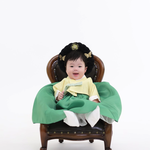
Visitors wearing hanbok (한복), traditional Korean dress, enter the palaces and Jongmyo without paying. This is a standing policy rather than a promotion, and it is why the courtyards fill with people in bright silk on any decent afternoon.
What qualifies is more specific than most people expect, and staff at the gate do check. You need a proper two-piece outfit — jeogori (저고리), the short jacket, worn with either the chima (치마) skirt or the baji (바지) trousers — put on correctly, jacket closed and tied. A single loose robe, a costume-shop approximation, or hanbok over jeans will not pass. Modernised or fusion hanbok is generally accepted provided the basic form is intact.
Rental shops cluster around Gyeongbokgung's east side, near Anguk Station, and along the Bukchon and Samcheong-dong lanes. The arrangement is standardised: you choose an outfit, staff help you dress and tie it, hair styling and accessories are offered as extras, and your own clothes and bag go in a locker. Rentals are sold in blocks of hours. Consider the season first — the layers are warm, and midsummer humidity or a January wind will shorten your enthusiasm. Spring and autumn are the comfortable windows, for the reasons set out in the post on the four seasons in Korea.
Bukchon Is Somebody's Street
Bukchon Hanok Village sits on the hillside between Gyeongbokgung and Changdeokgung and is often listed as an attraction. It is not one. It is a residential neighbourhood of hanok, traditional courtyard houses, and the famous sloping alley with the view over tiled roofs is somebody's route home from the shops.
The volume of visitors became a real problem for residents, and the district responded with posted visiting hours for the worst-affected lanes, quiet-zone signage and staff on duty at busy periods. The requests are not complicated: keep your voice down, do not photograph into windows or courtyards, do not sit on doorsteps, and do not turn up early or late. Samcheong-dong, immediately east, is the commercial street, and you can behave there like a visitor anywhere.
Closing Days Differ, and a Walking Order
The most common wasted journey is arriving on a closing day, and they are not uniform:
- Gyeongbokgung — closed Tuesdays
- Changdeokgung, Changgyeonggung, Deoksugung, Jongmyo — closed Mondays
Both days therefore need planning around, and it is worth confirming before you travel, since schedules shift for events and restoration.
For a full day on foot, start at Gyeongbokgung in the morning, timed for a guard ceremony. Walk east through Bukchon — quietly — and down to Changdeokgung for your booked Huwon tour, the fixed point everything else bends around. Carry on through the connecting gate into Changgyeonggung, then south to Jongmyo if the timing works. Leave Deoksugung and Gyeonghuigung for a separate outing near City Hall.
That northern group is strung along subway line 3 between Gyeongbokgung and Anguk stations, so you are never far from a way out if the weather turns. The public transport guide covers the card and the exits, and the road-name addresses the rental shops list are explained in the post on Korean age, names and addresses.