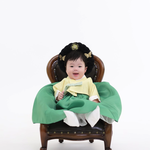
INa was born on 6 June 2024, which put her first birthday on 6 June 2025. In a lot of countries that would mean a cake, a few photographs and an early bedtime. In Korea it means 돌잔치 (doljanchi), a named occasion with its own table, its own clothing and its own small ceremony, and one that older Koreans still rank alongside a wedding as a day worth doing properly.
Why the First Birthday Carries So Much Weight
The usual assumption is that 돌잔치 is a first birthday party scaled up because Korean families enjoy an occasion. The real explanation is older and more sober. For most of Korean history, infant mortality was high enough that reaching a first birthday was not something a family could assume, and a child who had survived twelve months had cleared the stretch when illness, cold and poor nutrition were most likely to be fatal.
So the celebration began as relief made public, and the symbols on the table asked, fairly directly, for the rest of the life to go as well as the first year had. It also explains something that puzzles visitors: the guest list is not made up of the child's friends. A one-year-old has no friends. The people in the room are grandparents, aunts and uncles, cousins and the parents' closest colleagues, because the event was always addressed to the adult community rather than to the child.
백일 (baegil) Comes First
Before the first birthday there is 백일 (baegil), the hundredth day. Counting starts with the day of birth itself, so INa's hundredth day fell in the middle of September 2024. The logic is 돌잔치 in miniature: a hundred days was the first genuinely survivable milestone, and it was marked before anyone dared plan a year ahead.
The traditional marker is 백설기 (baekseolgi), a steamed rice cake of little more than rice flour, sugar and water. It is deliberately white and deliberately plain, standing for purity, and families historically handed it round to neighbours so the good wishes were spread rather than hoarded. Alongside it comes 수수팥떡 (susu patteok), a sorghum and red-bean cake, red being the colour long thought to turn misfortune away.
Most families now mark 백일 quietly at home with a cake and a photograph, and save the larger gathering for the first birthday. That is what we did.
The 돌상 (dolsang), and What Is On It
The centrepiece of a 돌잔치 is the 돌상 (dolsang), the first-birthday table. It is arranged rather than merely laid, and nearly everything on it carries a meaning.
- 백설기 (baekseolgi) — plain white rice cake, for purity and long life.
- 수수팥떡 (susu patteok) — red sorghum and adzuki cake, to keep bad luck off.
- 무지개떡 (mujigaetteok) — layered rainbow rice cake, for a full and varied life.
- 쌀 (ssal) — a bowl of uncooked rice, for never going hungry.
- 대추 (daechu) — dried jujubes, associated with a large family and many descendants.
- 실타래 (siltarae) — skeins of thread, for length of days.
- Stacked seasonal fruit, for plain abundance.
You will also be given 미역국 (miyeokguk), seaweed soup, which is eaten on Korean birthdays generally rather than only this one. The connection is to childbirth, since mothers eat it during recovery, so eating it on your own birthday quietly acknowledges the person who gave birth to you.
돌잡이 (doljabi): the Part Everyone Watches
The ceremony proper is 돌잡이 (doljabi). A small set of objects is set out in front of the child, the room goes quiet, and whatever the child reaches for first is said to hint at the shape of their life. Everyone photographs it.
The traditional objects are few and their meanings fixed. 실 (sil), thread, is long life. 쌀 (ssal), rice, is never going without. 돈 (don), money, is wealth. A 붓 (but), a calligraphy brush, or a 책 (chaek), a book, is scholarship — the old highest ambition, since passing the state examinations was the route into office. A 활 (hwal), a bow, once appeared on boys' tables for courage, and a 자 (ja), a ruler, on girls' tables for domestic skill. Those last two have largely dropped out.
Modern tables have absorbed newer ambitions instead. A 청진기 (cheongjingi), a stethoscope, stands for medicine; a 마이크 (maikeu), a microphone, for performing; a 판사봉 (pansabong), a gavel, for law. Nobody in the room treats the outcome as a prediction. It is a photograph and a story to tell the child later, and the parents usually have a quiet preference about which object happens to be nearest.
돌복 (dolbok), the Clothes
The child wears 돌복 (dolbok), first-birthday clothing based on 한복 (hanbok) but cut small and made comfortable enough to survive an afternoon. Girls typically wear a 저고리 (jeogori) jacket over a 치마 (chima) skirt, often with a 조바위 (jobawi) headpiece; boys wear a 저고리 with 바지 (baji) trousers and sometimes a 복건 (bokgeon) cap.
Most families rent rather than buy, because the outfit is worn once and outgrown immediately, and many venues fold the rental into the booking. Plenty of families put the child in 돌복 for the ceremony and the photographs, then change them into something washable before the food arrives.
How a Modern 돌잔치 Actually Runs
Two things have reshaped the event over the past couple of decades. The first is that it left the home. Korean flats are not built to hold thirty guests and a formal table, so most 돌잔치 now happen in hired rooms — dedicated halls, hotel function rooms, or private rooms at a restaurant. The venue supplies the 돌상, the decoration, a host to run the ceremony and a buffet.
The second is photography. A first-birthday studio shoot is close to standard, and it sits at the end of a sequence families work through in order: maternity photographs, newborn photographs, a fifty-day shoot, 백일, then 돌. Many families also cut a 성장 동영상 (seongjang dongyeongsang), a growth video, and play it at the party.
The gift convention is worth knowing if you are invited. The traditional present is a small gold ring, a 돌반지 (doljanji), because gold held its value and could be sold if the family ever needed it. Since the gold price moves, many guests now put cash in an envelope instead. Running against all of this is a visible shift towards what Koreans call 스몰돌 (seumol-dol), a "small dol": immediate family only, a rented 돌상 at home, no hired host.
What We Did for INa
We chose the small version. A hall booked for thirty people would have been about performing the day for an audience, and INa was not going to remember either option. So her 돌잔치 was family only, with a rented 돌상 set up in the living room, 돌복 borrowed rather than bought, and 미역국 that her grandmother made instead of a buffet.
We kept 돌잡이 exactly as it is traditionally done, because that is the part with the history in it. We put out thread, rice, a brush and a stethoscope. She went for the thread, which pleased the older generation in the room, since that is the one meaning long life — and given what 돌잔치 was originally for, it felt like the right object to end up in the photograph.
We did book the studio shoot, which was the one modern element we did not want to skip, and it is why there are proper photographs of her at one year old rather than only phone snapshots. If you want the story of how she came to be called 젤리꾸미 in the first place, that is in a separate post.
If You Are Invited to One
Go. It is one of the few occasions where a foreign guest sees a Korean family ritual performed in full rather than described. Bring cash in a clean envelope if you are unsure about the gold ring, dress as you would for a wedding reception rather than a children's party, and expect to eat properly. The usual Korean table conventions apply, and if those are unfamiliar we have written them up in our guide to Korean dining customs.
The one thing to get right is when to be quiet. During 돌잡이 the room stops talking and watches the child's hands. Follow the room, hold your photograph until afterwards, and you will have understood the occasion better than the guest who keeps chatting.