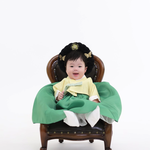
The name "Jelly GGumi" was given to me by my mom, inspired by my teddy bear-like appearance, soft and squishy like jelly. "GGumi" was actually my prenatal nickname, and it comes from the Korean word for dream. This is the story of where it came from, and why a Korean family gives a baby a name months before the baby has a legal one.
What 꿈 (kkum) Means
꿈 (kkum) is the Korean word for dream. It covers both senses the English word does: the thing that happens while you are asleep, and the thing you spend years working towards. It comes from the verb 꾸다 (kkuda), which is what you do to a dream — Korean does not "have" a dream, it "dreams" one, using a separate verb for the act.
When 꿈 is followed by 이, it is written 꿈이 and pronounced kkumi: the final ㅁ carries into the next spoken syllable. Our family turned that sound into the playful spelling 꾸미 for the prenatal nickname. That family spelling is the reason this site uses “GGumi” rather than claiming it as the official romanisation of 꿈.
Put the loanword 젤리 (jelli) in front and our nickname becomes 젤리꾸미 — Jelly GGumi. My mom thought the sound suited a cuddly little bear, so GGumi stayed.
태명 (taemyeong): the Name Before the Name
Giving a baby a nickname before birth is common enough in Korea to have its own word: 태명 (taemyeong), from 태 (tae), meaning womb or unborn child, and 명 (myeong), meaning name. Korean reporting describes the practice as widespread and records nicknames built from wishes, food and whatever the first scan reminded the parents of. We chose ours early in the pregnancy.
For our family, the reason was practical as much as sentimental. The legal name would be settled after birth, but meanwhile there was already a person we talked about every day. Calling her “the baby” felt cold, and the 태명 filled that gap.
Health wishes and affectionate food words are common patterns in the examples Korean parents report: 튼튼이 (teunteuni), from 튼튼하다, means sturdy; 콩 (kong) is a bean; and 딸기 (ttalgi) is a strawberry. Our nickname belongs to the wish-shaped group. At our own appointments, clinic staff used it too, and it was written on the ultrasound printouts. Those last details are our family's experience, not a rule every clinic follows.
The First Scan
The first time my mom saw me was when I was just a tiny little dot in her womb at five weeks. There is nothing recognisable at that stage. It is a small dark circle on a grey screen, and it is only meaningful because somebody tells you what it is. That is the point at which the name started being used out loud.
As the baby's space in her belly grew, my tiny form grew too, and I started to look more and more like a jelly bear.
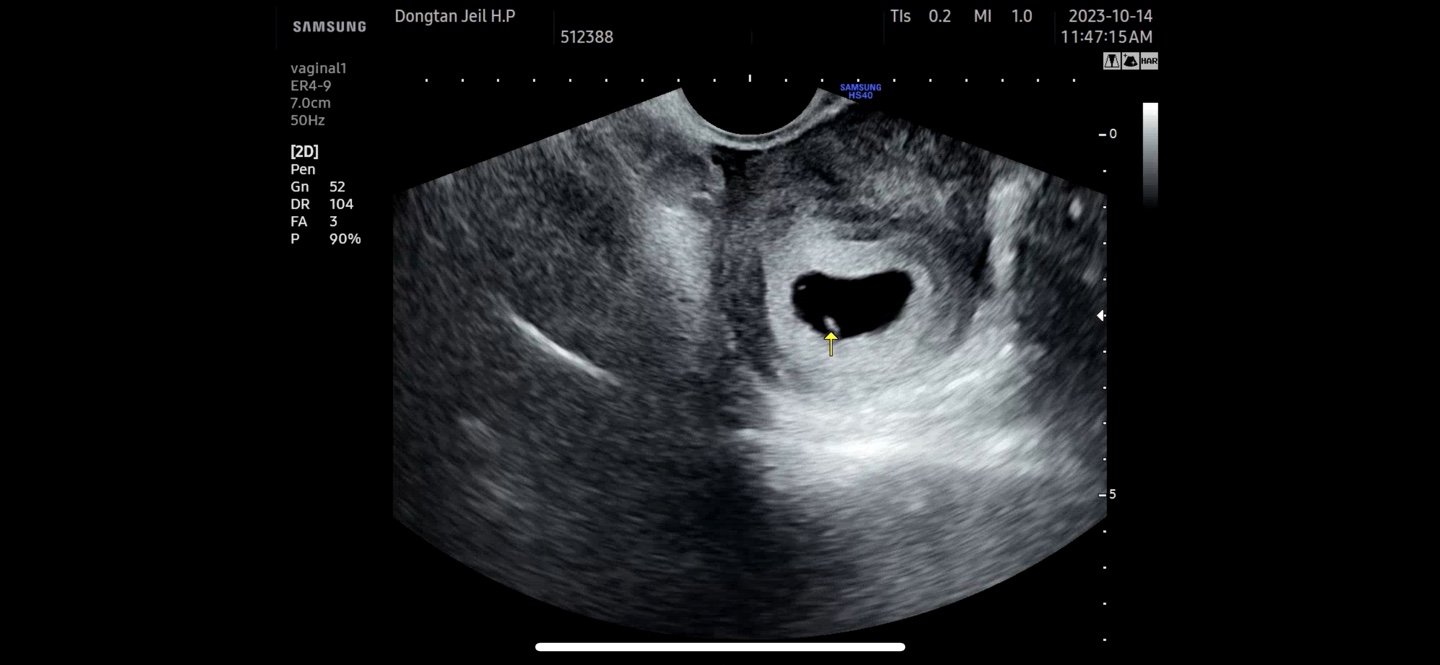
Jelly GGumi at first
© jelly_ggumi
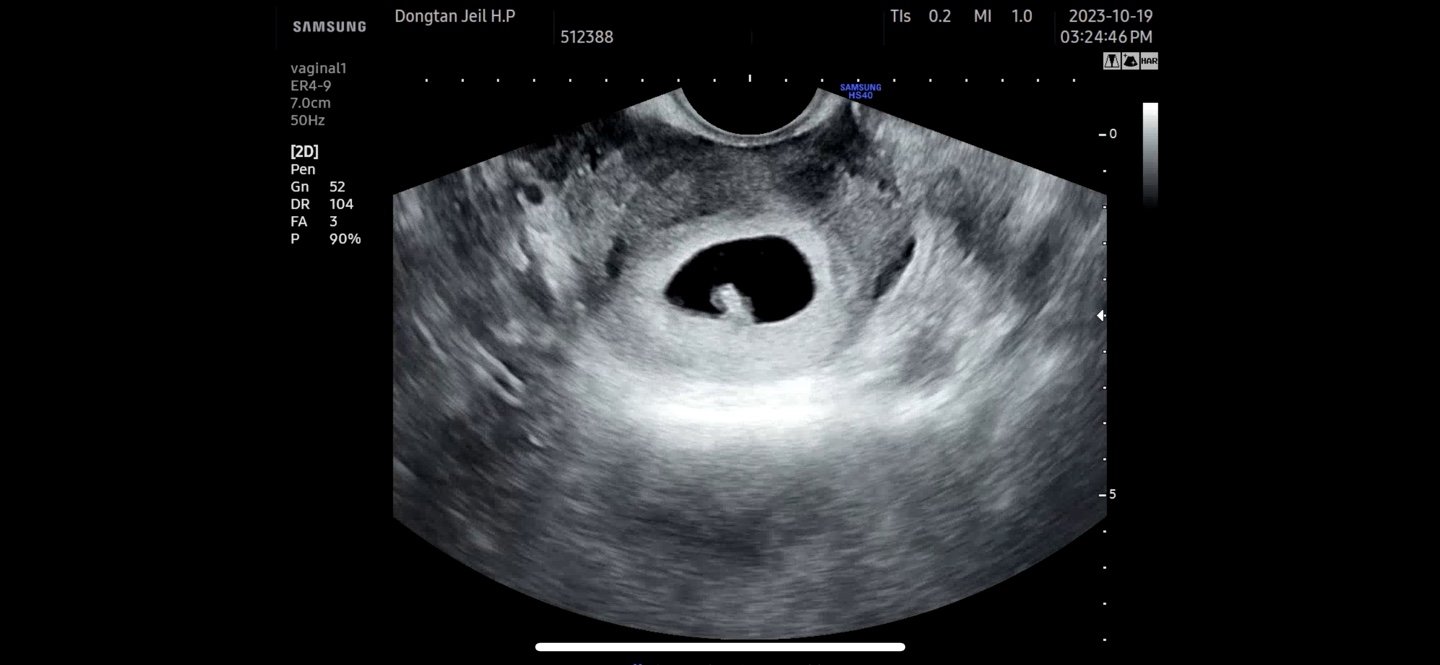
More bigger Jelly GGumi
© jelly_ggumi
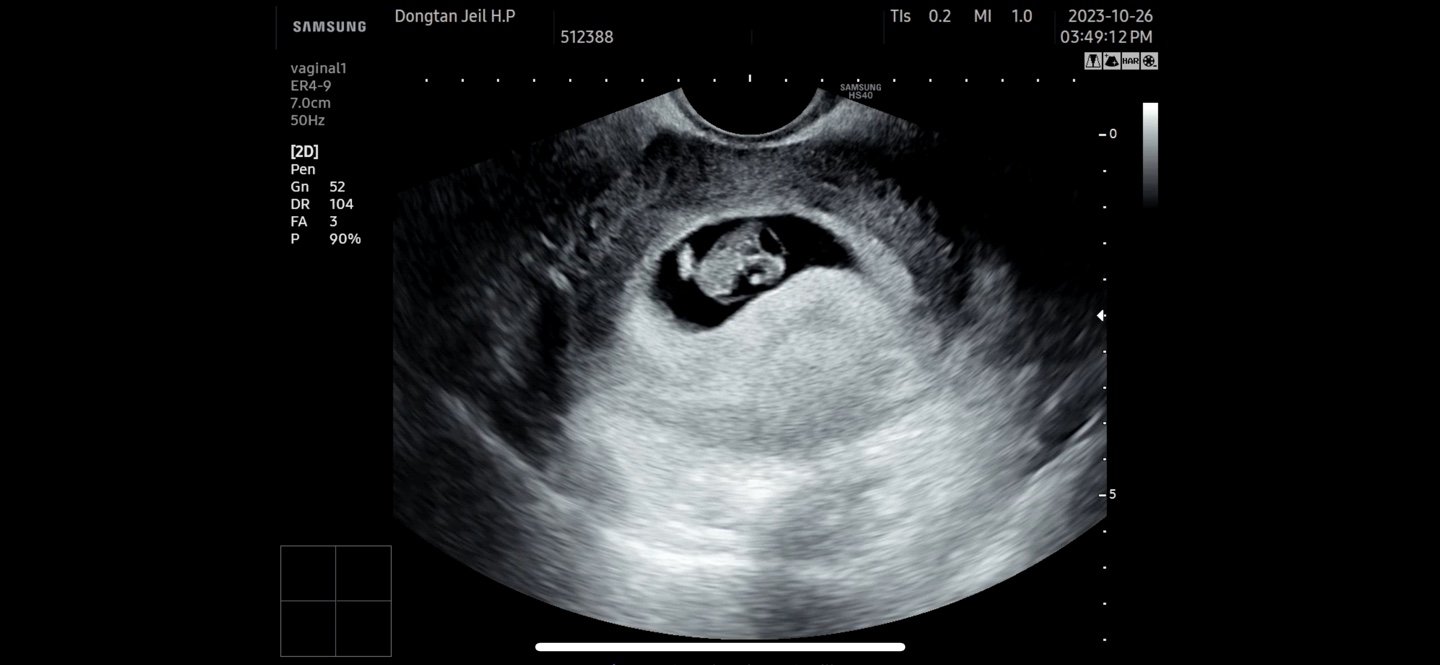
More bigger Jelly GGumi
© jelly_ggumi
Our prenatal appointments produced a long sequence of ultrasound images. Seeing the growth in so many small steps turned the photographs into something closer to a flip-book than a handful of isolated milestones.
Growing Out of the Frame
The scans that follow have their own rhythm. The early ones are about confirming that everything is where it should be. The middle ones are the detailed anatomy checks, and they are the appointments parents are quietly nervous about, because that is where anything unexpected would show up. By the later scans the concern has shifted to size and position, and the images stop being able to show the whole baby.
Eventually, I grew so big that I couldn't even fit into the ultrasound pictures anymore. That is a real turning point for the parents rather than a technical footnote. Up to then the baby is something you see whole, in one frame. After that you are looking at a head, or a spine, or a foot, and you are assembling the rest yourself. It is the point where the image stops explaining the baby and the name starts doing that work instead.
The Name on the Family Register
Korean names conventionally put the family name first, followed by the given name. In English-language contexts the order may be reversed, which is why the same name can appear in two different orders. For this family story, the affectionate nickname is the name that matters.
Korean given names are usually two syllables. Traditionally each syllable is tied to a Chinese character chosen for its meaning, and families sometimes share one character across every cousin in a generation, so the written name records where you sit in the family. Formal naming can go further still, with a 작명소 (jakmyeongso), a naming service, consulted for a combination considered auspicious.
Plenty of modern Korean parents step away from all of that and choose a name purely for how it sounds, which is what happened here. Two soft syllables, easy for a small child to say about herself, and — a consideration that would not have existed a generation ago — straightforward to romanise so that it survives being written in English.
Why We Started Writing This Down
Two reasons, and they turned out to be the same reason. The first is that we wanted a record. A growth diary is the sort of thing everyone means to keep and very few people actually do, and the difference between a folder of phone photographs and something written down is that only one of them explains itself later.
The second is that we kept answering the same questions. Friends and relatives outside Korea would ask about something that is completely ordinary here — why the baby had a name before she was born, why the first birthday is such a large occasion, why nobody worries about a parcel left in a hallway — and the honest answer usually needed a paragraph rather than a sentence. Most writing about Korea is either a tourist itinerary or an academic paper, and there is not much in between explaining how ordinary life actually works.
So the blog does both jobs. It is INa's diary, and it is the long-form answer to the questions we keep being asked. Our own first-birthday planning has its own dated record, and the general etiquette questions are collected in our overview of Korean cultural tips.
Still GGumi
What do you think of my growth journey? Do you think my mom picked the perfect name for me? The legal name is on the family register, but the one used at home is still 젤리꾸미, and that is the one that will end up in the stories she gets told about herself.
I'm going to be a dream come true for my parents. And someday, I'll be a dream for everyone who knows Jelly GGumi too.
Sources checked
Last reviewed August 29, 2026.
- National Institute of Korean Language – Romanization of Korean — National Institute of Korean Language
- Do Unborn Babies Need Names? In Korea, Absolutely — The Korea Herald
- Korean Names Look Simple – Structure, Meaning and Romanization — Ministry of Culture, Sports and Tourism
Schedules, prices and operating rules can change. Where a detail is time-sensitive, the linked operator remains the final authority.