The forecast offered rain, the baby offered two naps and Singapore offered far more than we could fit between them. We stopped trying to win the itinerary and let the day become smaller.
Field note: this is an English adaptation of our Korean diary entry published on 2 April 2025. The trip itself took place in December 2024, when INa was six months old. The point is not to prescribe the perfect Singapore itinerary. It is to record the day our itinerary mostly disappeared, and why that made the trip work better.
Before travelling with a baby, I planned days around places: breakfast somewhere local, one attraction, lunch, another neighbourhood, dinner. With a six-month-old, the fixed points were no longer places. They were the first feed, the next nap, another feed, and the moment everybody had enough energy to leave the hotel. On our fifth day in Singapore, steady rain made that difference impossible to ignore.
Hotel Breakfast Stopped Feeling Optional
Before INa, my husband and I rarely paid for hotel breakfast. We preferred to leave early and find whatever people nearby were eating. That approach had always felt more interesting and usually cheaper.
A baby changed the calculation. INa woke at her usual time, which meant we did too. By the time we had fed her, changed her, packed what we needed and considered her next nap, looking for a separate breakfast place no longer felt spontaneous. It felt like moving a small household before either adult had eaten.

The hotel buffet solved several problems at once. We could take turns at the food stations without folding the stroller, choose something quickly, and give INa small pieces of boiled egg and papaya while we ate. Nobody was waiting for us to finish a full restaurant sequence. If she became restless, one parent could walk with her while the other finished.
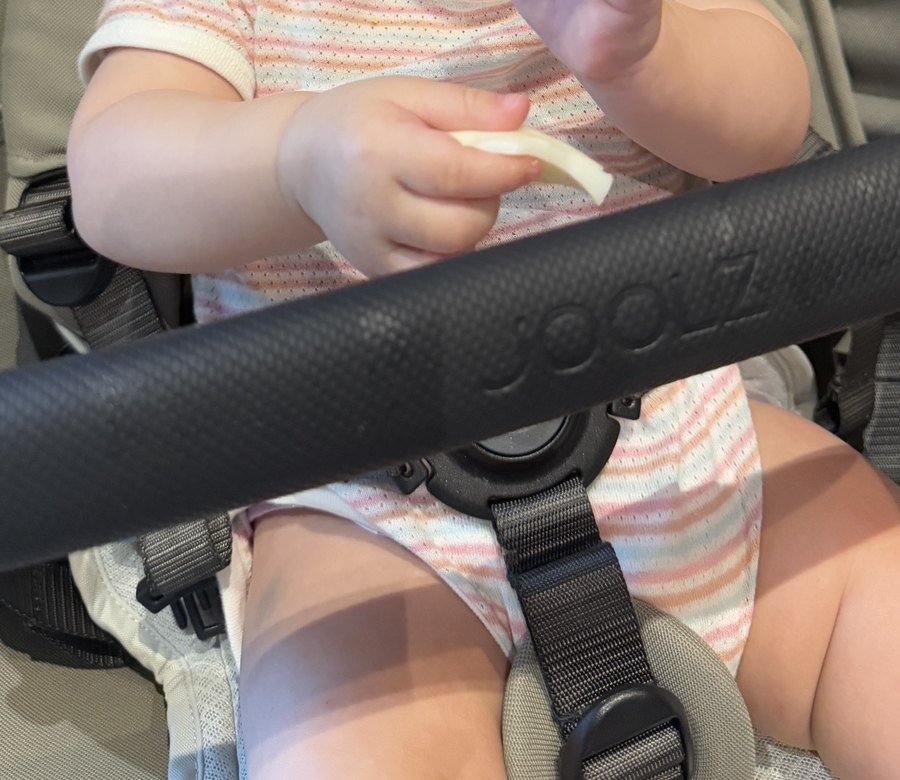
The lesson was not that every family should buy a breakfast package. It was that the price buys more than food when a baby's day has already started. It buys a meal within lift distance of the room, no transport decision, no queue research and a quick retreat if the morning goes wrong.
The Nap Was the Schedule
After breakfast we walked beside the Singapore River in front of the hotel. The air was still mild, the sky was grey and the rain had not begun. Our plan was to wash, pack and go out again.
When I came out of the bathroom, father and daughter were asleep side by side. Waiting for them felt like losing the morning only if I kept pretending the old itinerary still applied. In reality the nap was the schedule. Waking INa to protect a sightseeing plan would have moved the problem into every hour that followed.
By the time they woke, light rain had started. We fed INa first and stopped asking how to rescue the original plan. Instead we asked what the hotel could do for us.
Rain Turned the Hotel into the Destination
The answer was the pool. My husband handled swimming while I sat down after the morning's packing and feeding. The rain continued, but the water was not cold and INa was happy in her float. That hour was not a consolation prize. It was one of the clearest memories from the trip.
When the rain became heavy, we stayed under cover beside the pool and ordered a coffee and sandwiches from the restaurant. It was expensive enough that we shared one coffee, a detail that still makes me laugh, but it prevented another wet journey with a hungry baby. By the time we finished, the swim had done its work: INa slept again, the adults showered, and everyone reset.
This changed how I think about choosing a hotel for family travel. A good location matters, but a usable fallback matters too. A pool, a covered lobby, food on site and somewhere to walk without transport can save an entire weather day.
Choose One Indoor Anchor, Then Watch the Weather
When the rain eased, we chose one destination: Marina Bay Sands. It was connected to the MRT and gave us food, shelter and something to see without committing to a sequence of timed attractions.
We passed Bacha Coffee, but the queue was long and we were already hungry. We kept moving to Toast Box and ordered laksa and kaya toast. The decision was ordinary and useful: with a baby, the place that can feed everyone now is often better than the place you saved on a list.
After eating, we went to the Apple Store because I wanted to see its waterfront exterior. This is where the route on a map and the route with a stroller separated. The connection we found from below used an escalator, and an external entrance appeared to be closed in the rain. We eventually folded the stroller, carried INa and went in that way.
That is a record of what happened on our visit, not a claim that there is no accessible route today. The practical lesson is to budget time for finding lifts and level entrances in a large complex, especially when weather changes which doors are open.
Skipping an Attraction Can Be the Better Visit
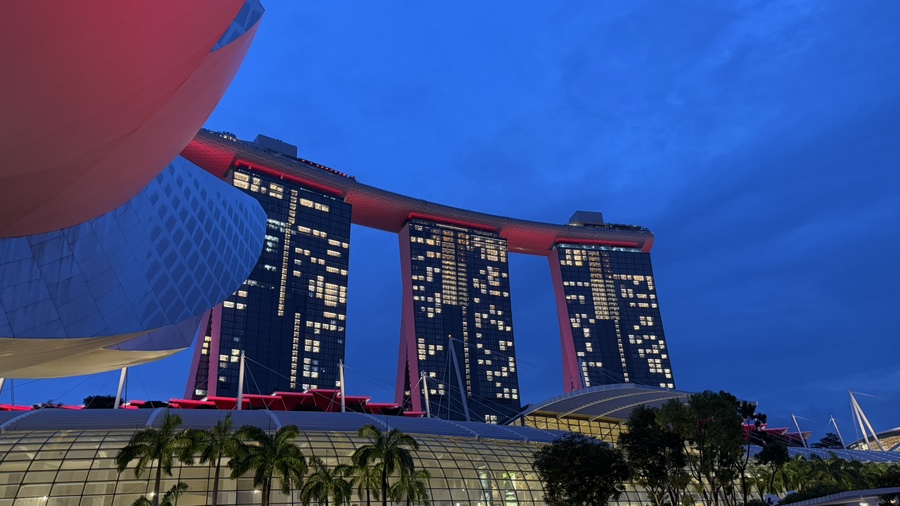
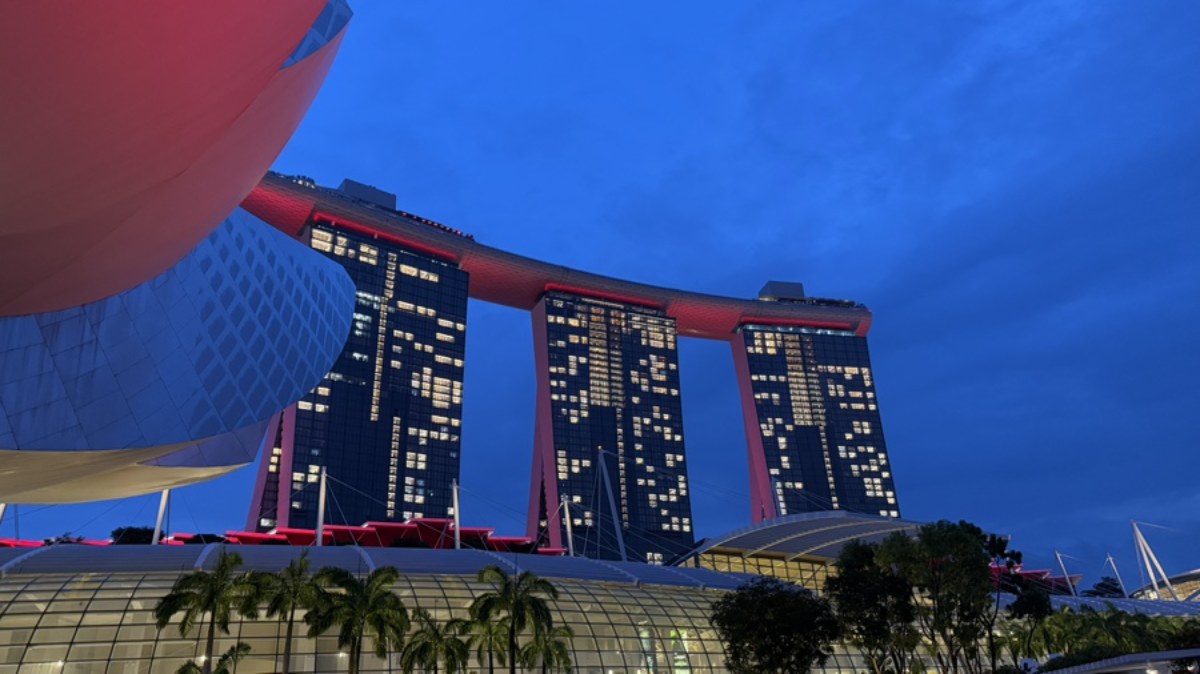
As the rain weakened again, we walked outside. Marina Bay Sands glowed against a deep cobalt sky, and the buildings were enough to make the walk feel like an event.
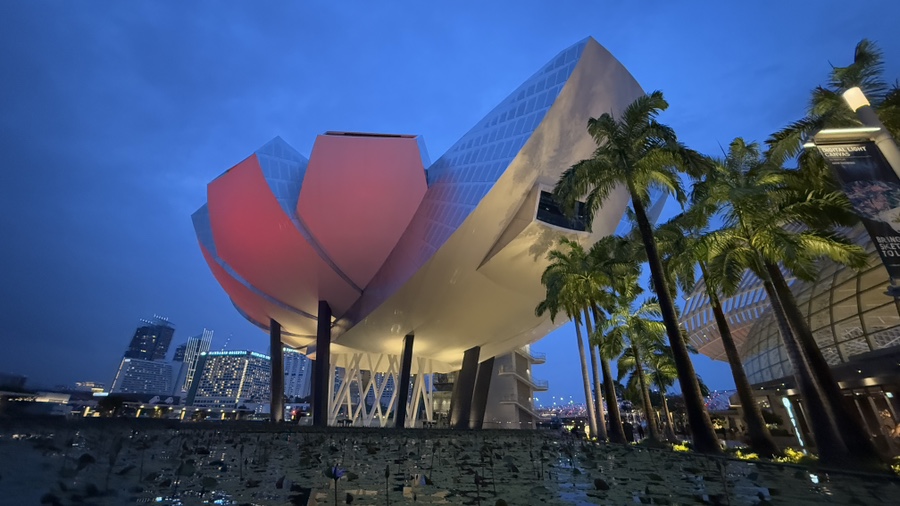
The ArtScience Museum was beside us, with a media-art exhibition inside. We chose not to buy tickets. At six months, INa could not walk through the space or engage with it in the way an older child could. We would have been paying to hurry around an exhibition between feeds while carrying her. Seeing the building, taking a slow walk and saving the interior for another trip felt honest rather than disappointing.
Family travel has a quiet pressure to prove that the journey was worthwhile by collecting famous places. That pressure is expensive. A baby does not know whether a photograph came from inside the attraction or beside it; she knows whether she is comfortable and whether her parents are tense.
We Were Right Not to Pre-Book the Outdoor Show
We moved toward Gardens by the Bay hoping to see the seasonal Supertree show. Because it had rained all day, we had deliberately not bought tickets in advance. Near showtime the light rain became a downpour, and the crowd around the MRT route was so dense that getting through with the stroller felt unrealistic.
So we watched the Supertrees from farther away while INa had her feed. It was not the image I had pictured before the trip, but it was the situation we actually had. Waiting to buy weather-dependent tickets had protected both the budget and our mood.
We eventually reached the train, returned near the hotel and dodged the remaining rain on foot. INa had stayed mostly dry under the stroller cover. We washed her in warm water, put her to sleep, and then sat on the terrace with the hotel's TWG tea. We knew it was our last night with that view.
What I Would Repeat on the Next Family Trip
- Buy convenience where it protects the morning. Hotel breakfast was worth more to us than another restaurant search.
- Plan around feeds and naps, not against them. One well-rested afternoon is more useful than a rushed morning attraction.
- Choose a hotel with a real fallback. On-site food, a pool and covered common space turned rain into a different kind of day.
- Give the day one anchor. Marina Bay Sands was enough; everything after it could remain optional.
- Treat stroller routing as its own task. A short pedestrian connection can involve a long search for a lift or an open level entrance.
- Delay weather-dependent purchases. Flexibility had more value than a reserved slot during a tropical downpour.
- Let “we saw it” be enough. We did not need to enter every building to have a memorable day around the bay.
Nothing about this day would qualify as efficient sightseeing. We ate in the hotel, waited through two naps, swam while it rained, visited one complex, skipped a museum and missed the show we had considered. Yet it is the day that best explained travelling with INa. The successful plan was not the one that survived unchanged. It was the one that could bend without making any of us feel that the day had failed.
Sources checked
Last reviewed August 29, 2026.
- Original Korean trip diary – Singapore day five — JellyGGumi Naver Blog
Schedules, prices and operating rules can change. Where a detail is time-sensitive, the linked operator remains the final authority.