Every November, Korea performs a famous act of collective quiet. For one Thursday, offices are asked to open late, military exercises pause, and for twenty-five minutes in the early afternoon, planes stop taking off across the entire country so that half a million students can hear an English listening test. Outside accounts of Korean education tend to begin here, on suneung day, with the grounded aircraft.
Here is the part that coverage usually skips: by the time that Thursday arrives, most of the university seats in Korea have already been spoken for. The round that decides most outcomes begins in September, it is called susi, and in the 2027 admissions cycle it holds 80.3% of the planned seats — a touch more than four in five. The famous exam is, for a large majority of seats, not the main event. It is the later round, and the second chance.
Two rounds, one calendar
Korean university admission runs on a statutory calendar. Under Article 34-5 of the Higher Education Act, the Korean Council for University Education — the body of all 195 four-year universities — compiles each university's admission design into one joint national plan and publishes it. For the 2027 academic year, that plan sets a total of 345,717 seats, split into two rounds: 277,583 seats (80.3%) in the early susi round, and 68,134 seats (19.7%) in the later jeongsi round.
The two rounds judge different things. Susi is decided mostly on school records: 85.8% of its seats use school-record tracks, split between a mechanical GPA-based screening (156,403 seats) and a holistic file review (81,931 seats). Jeongsi is the mirror image — 92.7% of its seats are awarded principally on suneung scores. So the November exam matters enormously, but the seats that hinge principally on it are the one-in-five slice that waits for the later round.
The susi share was not always this lopsided, though it has been trending that way for years. The same council table shows 79.6% for the 2025 cycle and 79.9% for 2026; the 2027 cycle is the first time the early round crosses 80%.
Five days in September
The susi application window for the 2027 cycle ran from 7 to 11 September 2026, with each four-year university required to accept applications for at least three days inside that band. Junior colleges run a longer first round, from 7 to 30 September. After the window closes, universities screen files from 12 September to 17 December — a 97-day stretch — and must announce acceptances by 18 December. The jeongsi window then opens in the first week of January.
If you were in Korea in early September and noticed a spike of admissions talk, this window is what it was about. It recurs each year on a similar schedule, published well in advance in the council's joint plan and basic-rules documents.
The six-envelope rule
A student may file at most six susi applications. The count is per application track, not per university — apply to two different tracks at the same university and you have used two of your six. File a seventh anywhere and the excess application is void.
Each application carries its own fee, because there is no nationally fixed price: each university sets its own under a cost-recovery principle, must publish its fee budget and settlement, and must return any surplus to applicants in proportion to what they paid — while an application, once the window closes, generally cannot be cancelled or refunded. Six applications is therefore not just a strategic budget but a literal one.
The rule shapes September strategy the way a hand of six cards would: how the six are spread across reach, match and safety choices is the season's central decision.
The one-way door in the middle
Here is the mechanism that gives susi its weight, and its occasional heartbreak. Anyone accepted in the susi round — and this explicitly includes waitlist acceptances — cannot apply in that year's jeongsi round or in the additional rounds after it. The ban attaches to being accepted, not to enrolling; the council's rules state that violations are caught by computerized cross-checking, and a violating admission is void.
In practice this means a susi acceptance is a one-way door. A student who is accepted in December by a safety choice, then outscores everyone's expectations on the suneung, cannot take that score to a better university in January. The choice of which six envelopes to send in September therefore has to be made before any exam result exists, while carrying consequences that survive the exam.
Why the exam still owns November
None of this makes the suneung small. 551,864 people registered for the 2027-cycle exam, held on Thursday 19 November 2026, with scores released on 11 December. And the registration list carries a telling detail: only 64.4% of registrants are current high-school seniors. 173,706 people — 31.5% — are graduates, a group whose most direct route back into admissions is the exam-scored jeongsi round.
That is the quiet arithmetic behind the famous exam-day theatre. The state machinery still mobilizes nationally: for the November 2025 exam, the government asked offices and businesses to push start times past 10 a.m., adjusted aircraft and helicopter movements, and halted artillery fire and tank movement during listening periods. The transport ministry's standing pattern grounds takeoffs nationwide and holds airborne aircraft above three kilometres during the English listening window — 13:05 to 13:40 on the 2025 exam day — covering everything from airliners to drones.
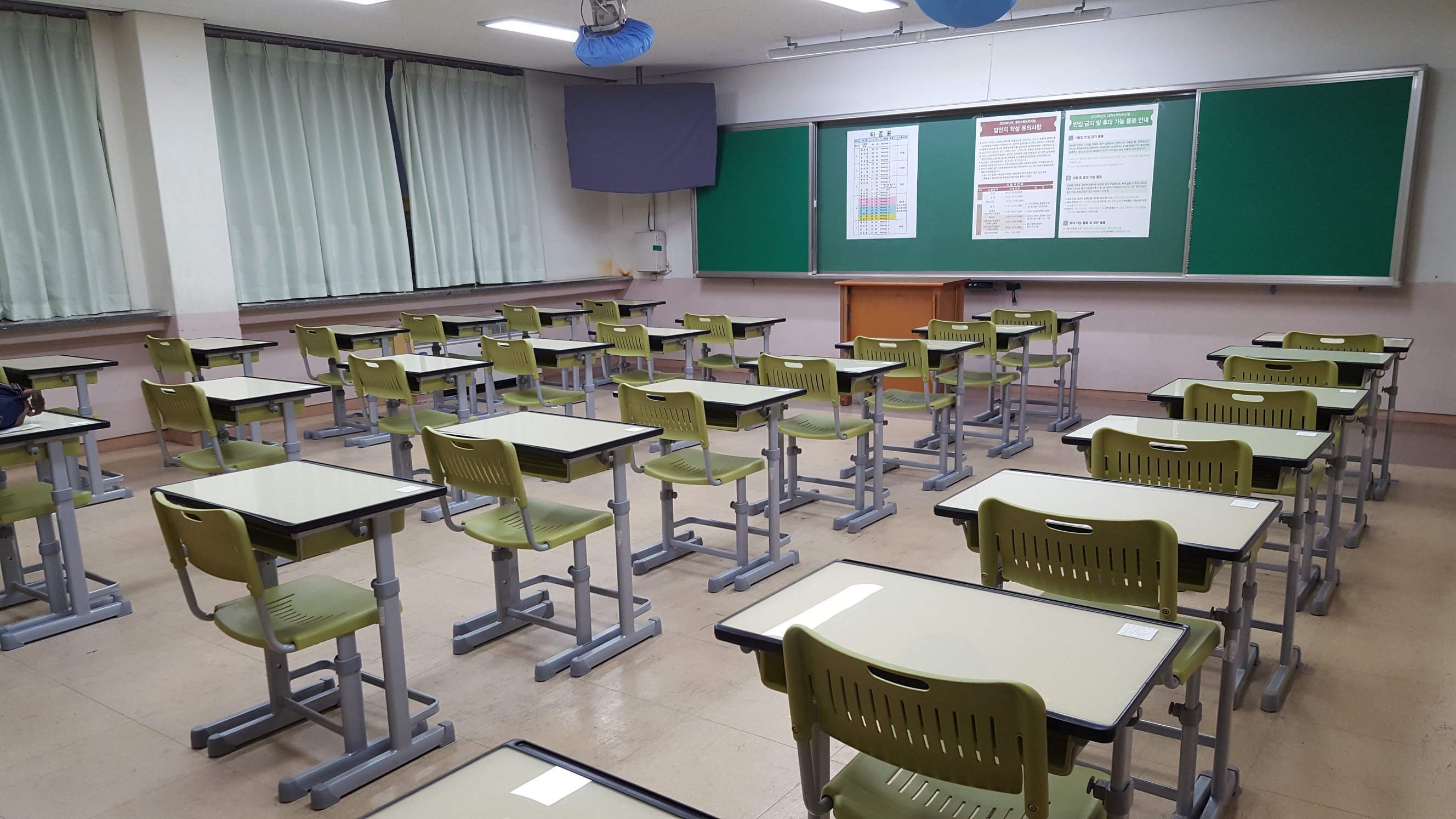
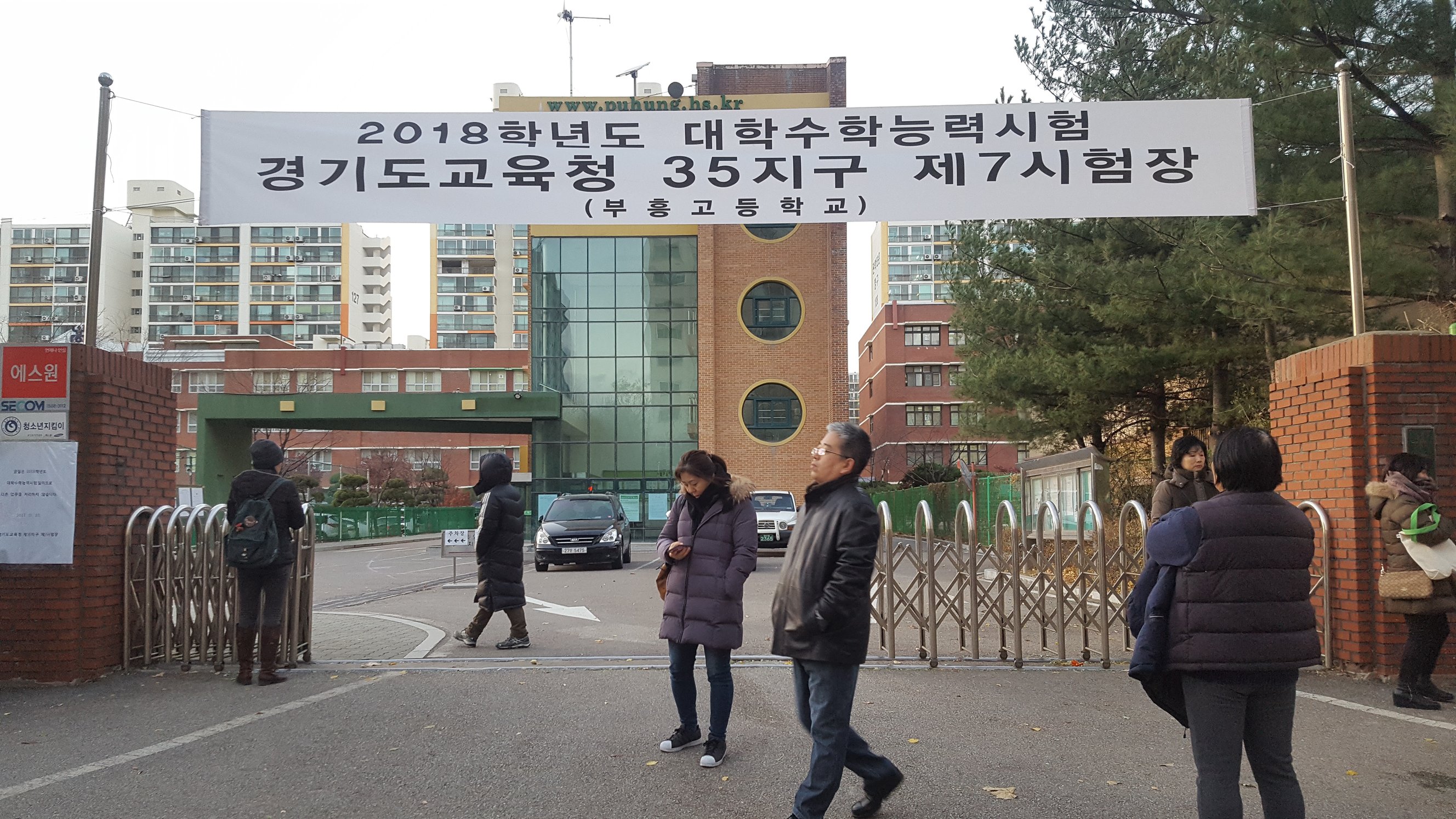
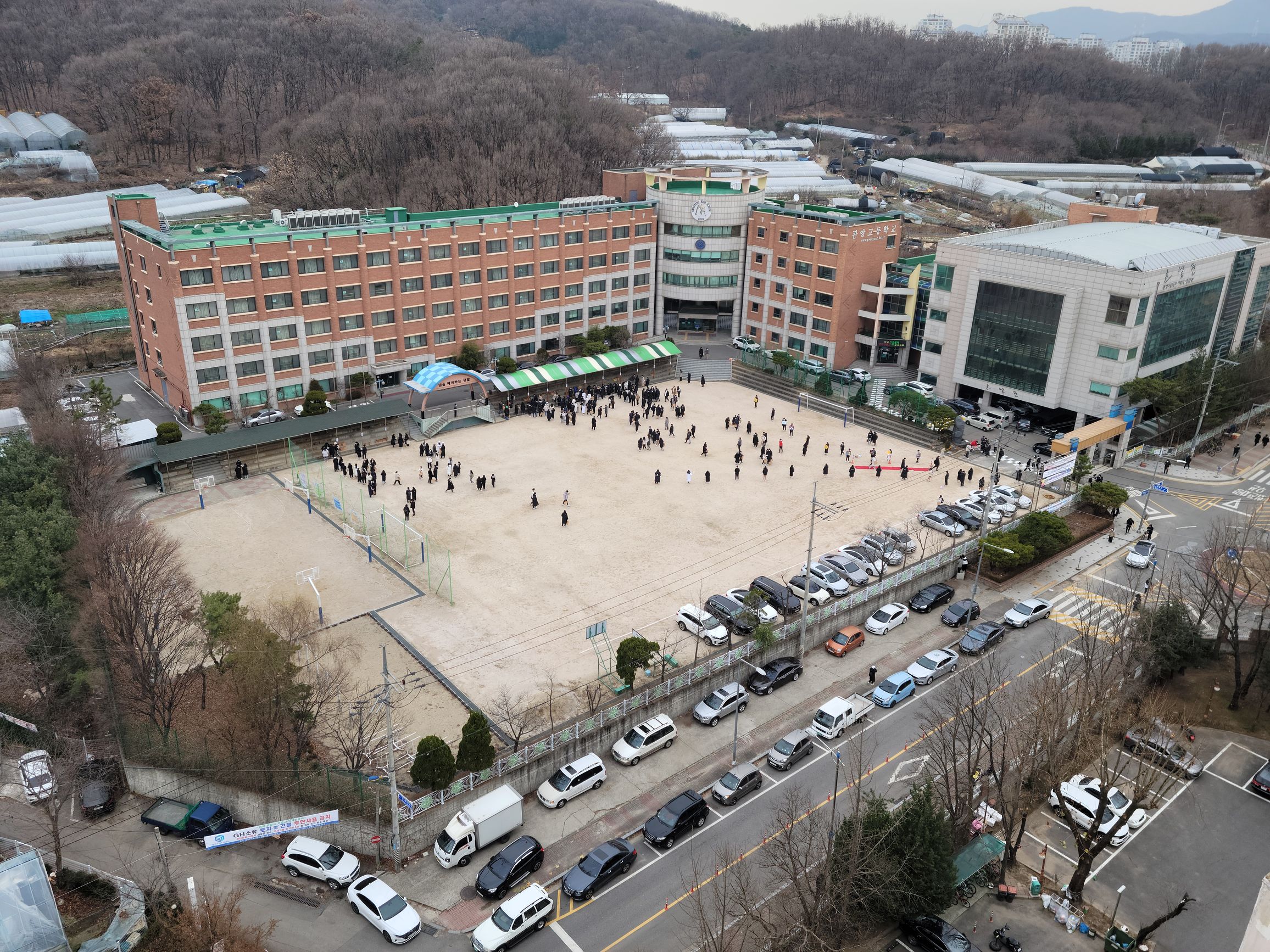
The day before the exam has its own ritual, the preliminary call-up, when candidates report to their assigned test sites. The photograph below shows what that looks like from above.
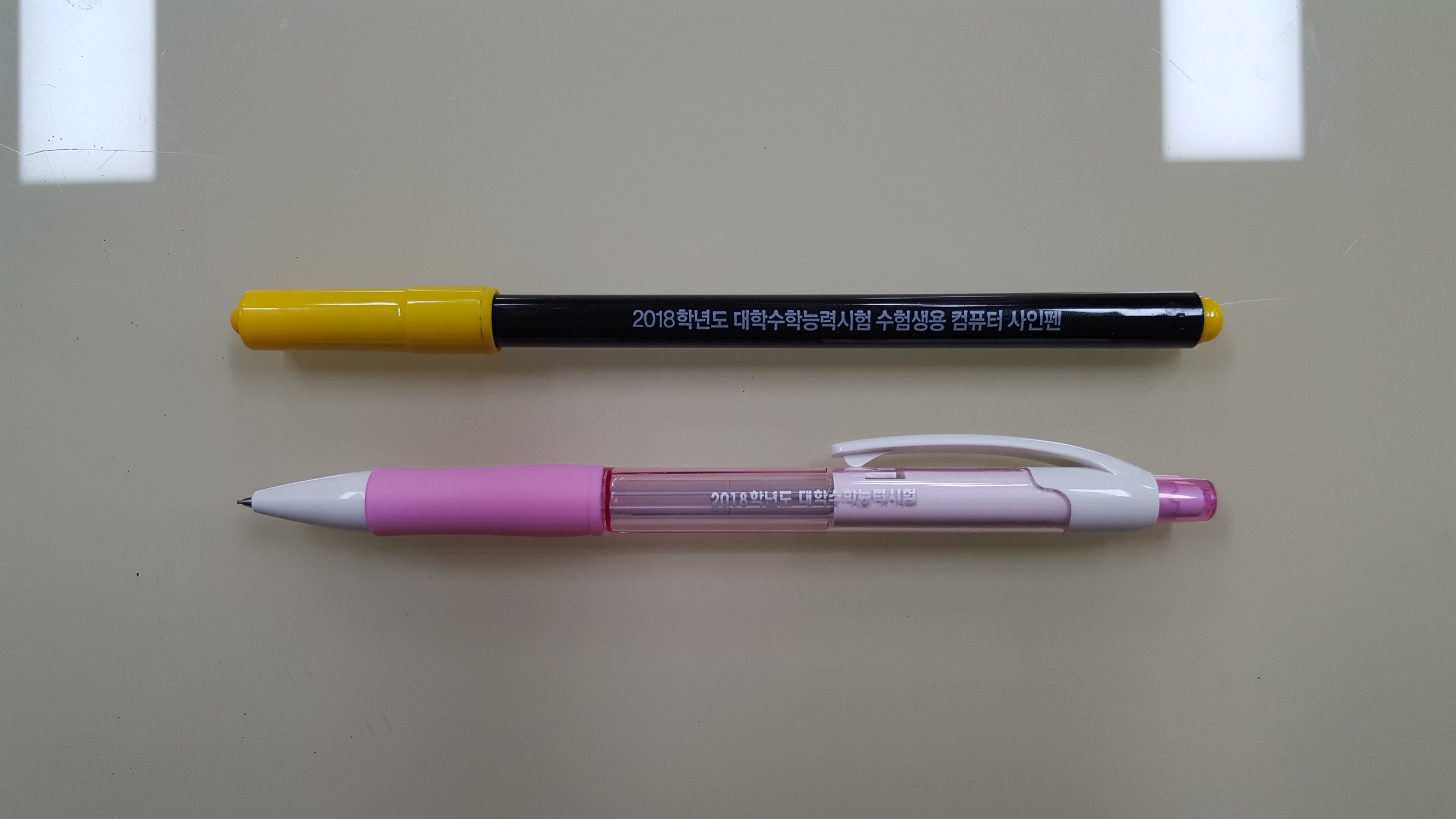
Even the stationery is standardized: the computer-marking pen in the photograph below is printed for exam candidates, one of the small uniform objects of the day.
Seats set aside on purpose
One more structural fact rarely makes it into English: not every seat is an open contest. Of the 345,717 planned seats in the 2027 cycle, 78,926 — roughly one seat in 4.4 — are reserved under equity and regional tracks: 37,324 opportunity-balance seats for students from disadvantaged backgrounds, 13,872 regional-balance seats, and 27,730 regional-talent seats that recruit students from a university's own region.
Put together, the system reads differently from its reputation. The picture that usually travels abroad is of a single brutal exam day deciding everything. The picture in the council's own tables is a September round of school records and six carefully chosen envelopes deciding most things, an acceptance rule that locks those choices in, and a November exam that remains decisive mainly for the fifth of seats that wait for it — and for the third of test-takers who have already graduated and come back for another try.
Editorial method: AI assisted with the research and the first draft. Every seat count, share and application rule here is taken from the Korean Council for University Education's 2027 admission plan, basic-rules document and August 2026 application notice; the exam date and the registration figures from the Ministry of Education and KICE; and the flight restrictions and exam-day measures from the transport ministry's and the government briefing service's releases for the November 2025 exam, which is why those are dated to 2025. The campus and exam-day photographs are Wikimedia Commons files credited in their captions, and the cover was made with AI image generation.
Sources checked
Last reviewed September 11, 2026.
- 2027학년도 대학입학전형시행계획 발표 (2025-04-30 보도자료, 첨부 PDF) — 한국대학교육협의회 (Korean Council for University Education)
- 2027학년도 대학입학전형기본사항 (개정 2026.07., 첨부 PDF) — 한국대학교육협의회 (Korean Council for University Education)
- 2027학년도 수시모집 대입 원서접수 미리 작성!! (2026-08-25 보도자료) — 한국대학교육협의회 (Korean Council for University Education)
- 2027학년도 대학수학능력시험은 2026년 11월 19일(목)에 시행됩니다 (2024-08-16 보도자료) — 교육부 (Ministry of Education)
- 2027학년도 대학수학능력시험 응시원서 접수 결과 (2026-09-08 보도자료) — 교육부·한국교육과정평가원 (Ministry of Education / KICE)
- 수능 영어듣기평가 시간, 항공기 소음 통제 (2025-11-11 보도자료) — 국토교통부 (Ministry of Land, Infrastructure and Transport)
- 2026학년도 대학수학능력시험 당일 안정적 시험 시행을 위한 지원대책 (2025-10-21 정책브리핑) — 대한민국 정책브리핑 (korea.kr)
Schedules, prices and operating rules can change. Where a detail is time-sensitive, the linked operator remains the final authority.