By early September, the crab tanks at Korean fish markets are busy again. Rubber-banded claws, wet floors, vendors calling out weights: after two quiet months, the churn is back. The quiet was not a supply problem. In most Korean waters, catching blue crab between 21 June and 20 August is simply against the rules, and the autumn market reopens on the far side of that ban.
The crab in question is 꽃게 (kkotge, the swimming crab Portunus trituberculatus), the most familiar eating crab in Korea. Ask when it is in season and the standard answer is a riddle: twice a year, and each time it is a different crab.
Two seasons, two different crabs
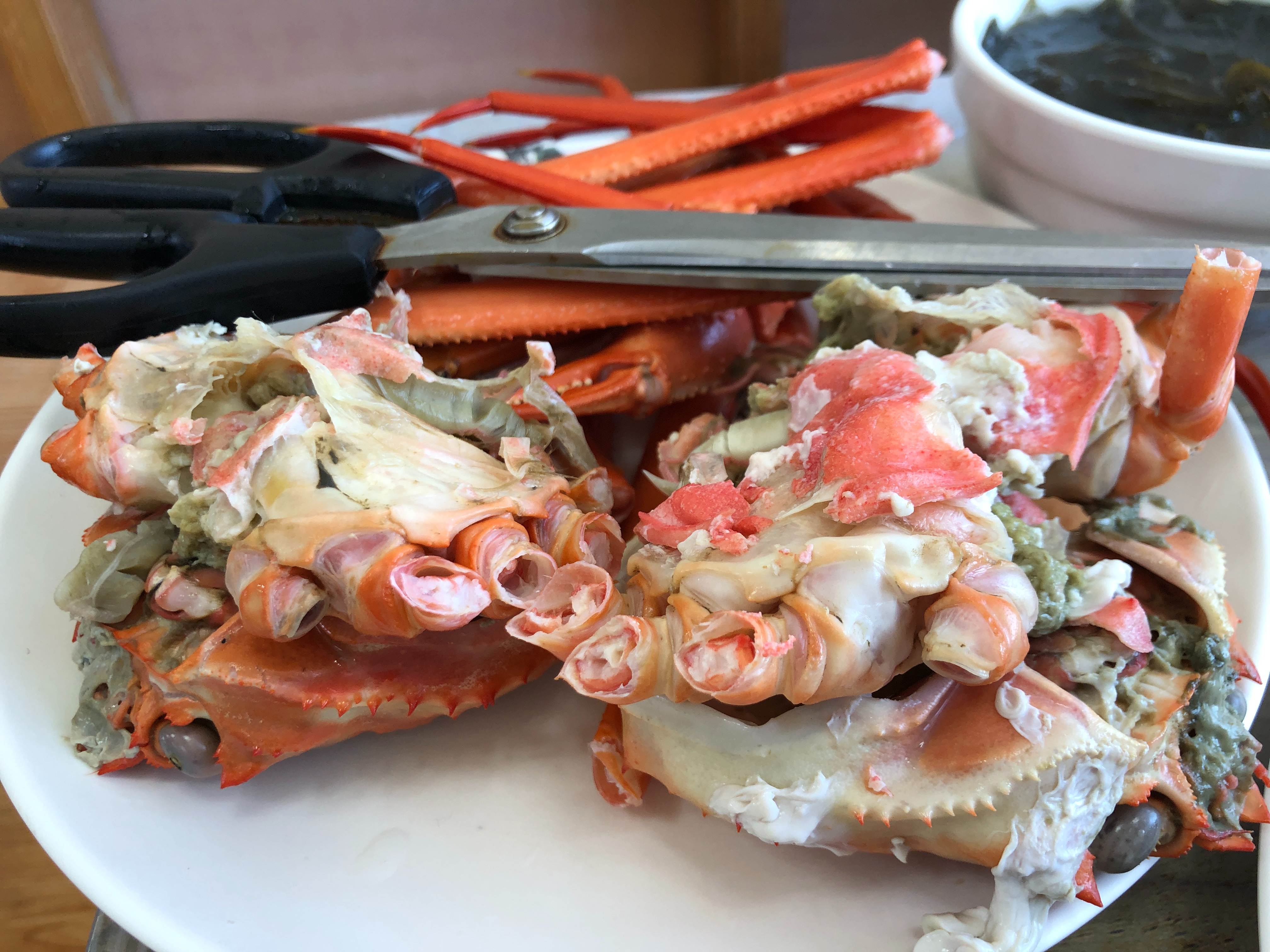
The fisheries food-information service run by Korea's oceans ministry states the rule plainly: crab reaches markets all year, but spring and autumn count as the seasons. In spring, female crabs are prized because they carry roe. In autumn, the males have filled out with meat. And the service adds the caveat that explains many a market-stall conversation: a female caught in autumn, just after spawning season, has not yet refilled, so autumn females are considered the lesser crab.
That last line is worth keeping. It means the same animal that commands spring's highest prices can be the bargain bin of September, not because anything is wrong with it, but because its calendar and the market's calendar disagree. If an autumn stall seems to be almost giving female crabs away, that is the reason.
The biology under the calendar
The National Institute of Fisheries Science gives the crab a short, hurried life. It lives about three years, spawns from May through September with a peak in June and July, and a female spawns two to three times in a year. The species lives on sand and muddy-sand bottoms of the West and South seas, at depths from two metres down to about a hundred and ten.
The oceans ministry's species guide fills in the travel schedule: blue crabs spend winter dormant in distant waters off the south-western West Sea, then from late March migrate back toward the coasts to spawn. That migration is what delivers the roe-heavy females of April and May close to shore — and the summer spawning that follows is what empties them out by September.
The law in the middle
Between the two seasons sits a legal wall, and its construction is more interesting than a single date. The enforcement decree of the Fisheries Resources Management Act (수산자원관리법) does not actually fix the crab's closed season. Its annex instead directs the oceans minister to designate, by public notice, a ban of up to two months falling somewhere between 1 June and 30 September.
The currently noticed window for general waters is 21 June to 20 August. But the West Sea islands nearest the maritime border run on their own clocks: around Yeonpyeongdo the ban is 1 July to 31 August, and around Baengnyeongdo, Daecheongdo and Socheongdo it is 16 July to 15 September. So there is no single day on which "crab season" opens in Korea; the autumn catch starts on 21 August in most waters, on 1 September off Yeonpyeongdo, and not until 16 September in the far north-west.
Those island dates are also recent. In April 2024 the ministry moved the Baengnyeong-Daecheong-Socheong window fifteen days later — it had been 1 July to 31 August — citing shifts in the crab's growth timing as water temperatures change, and years of requests from fishers in a border area whose operations are frequently restricted. The closed season is not a fossil; it is an actively tuned instrument.
There is a second rule that works year-round: no one may take a blue crab whose carapace — the 두흉갑장, measured across the head-and-thorax shell — is 6.4 centimetres or less. That number matches, exactly, the size at which the science institute's page says the species reaches maturity: the legal floor and the biological threshold for breeding coincide.
Reading the tank like a local
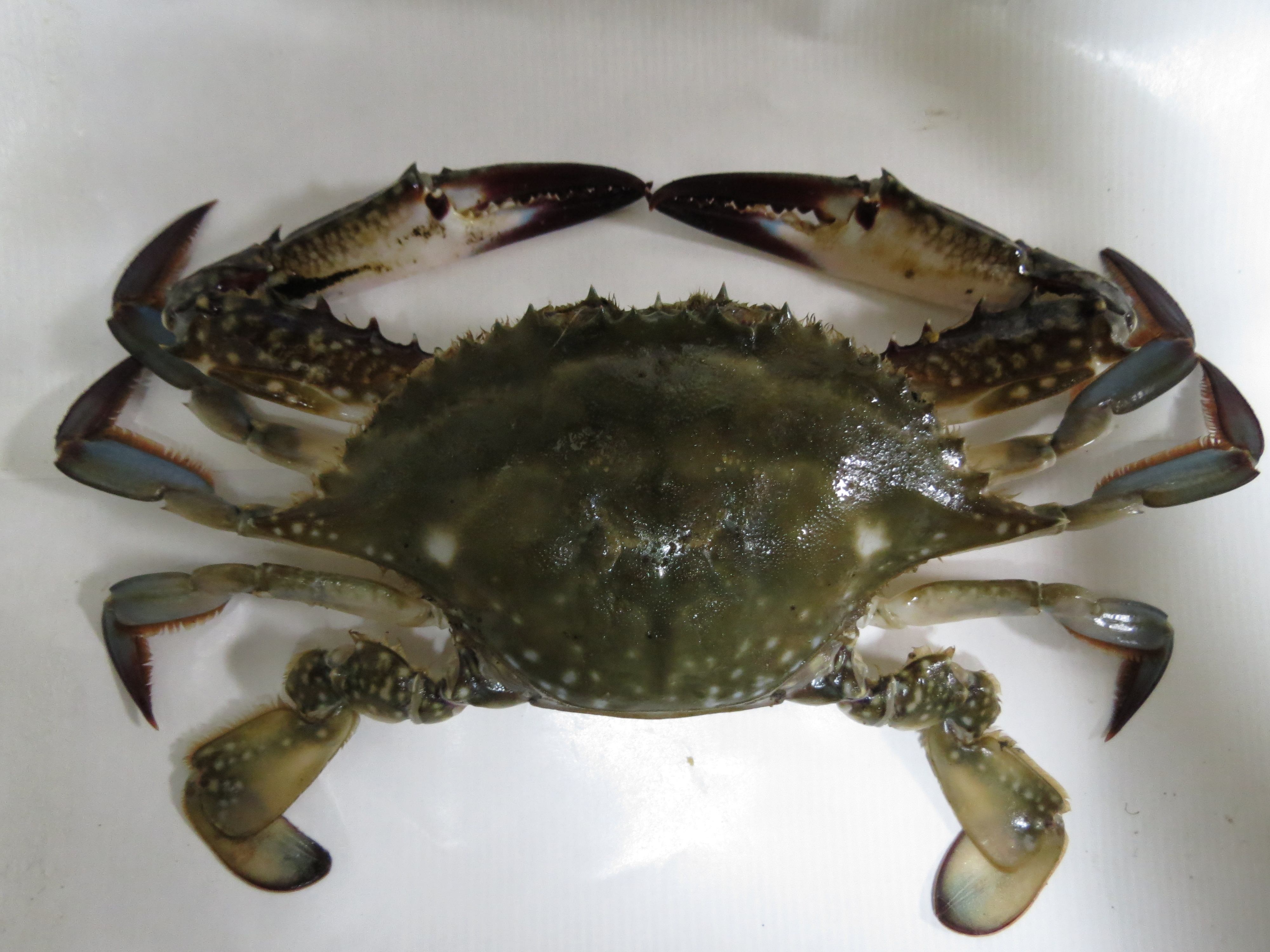
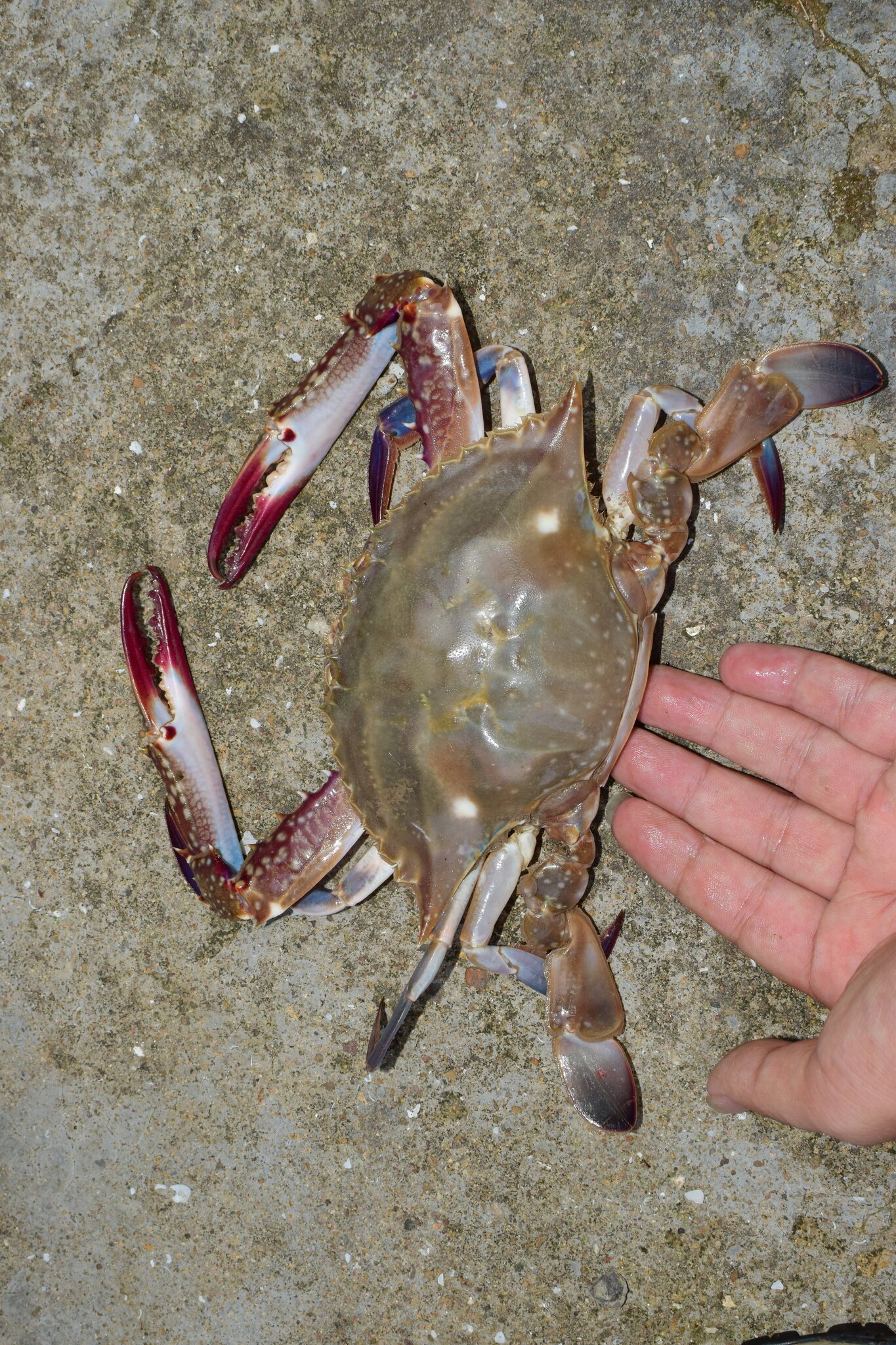
Sexing a crab at the market is easier than it sounds. The food-information service describes the female as rounded in outline with a dark brown shell, while the male runs pointed and triangular, in a greenish dark brown. Flipped over or compared side by side, the difference shows at a glance, and in season the sex is half the price tag.
The dish tells you which crab to want. Ganjang-gejang — raw crab marinated in soy sauce — is the preparation that makes spring females an object of devotion, because the marinade seasons the roe as much as the meat. Autumn is for steaming: kkotge-jjim puts the fattened males' meat at the centre, and crab added to a soup base makes the classic kkotge-tang.
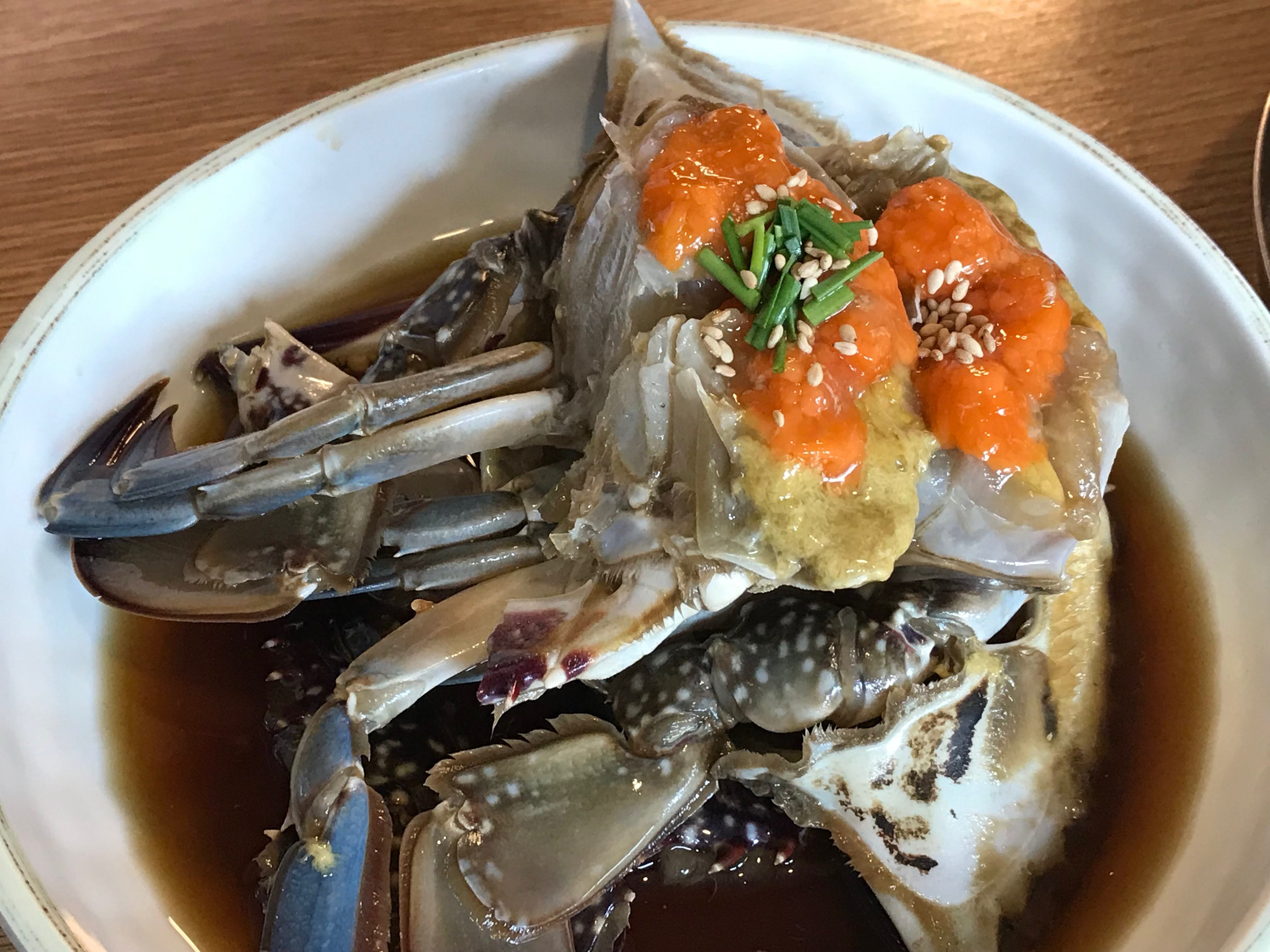
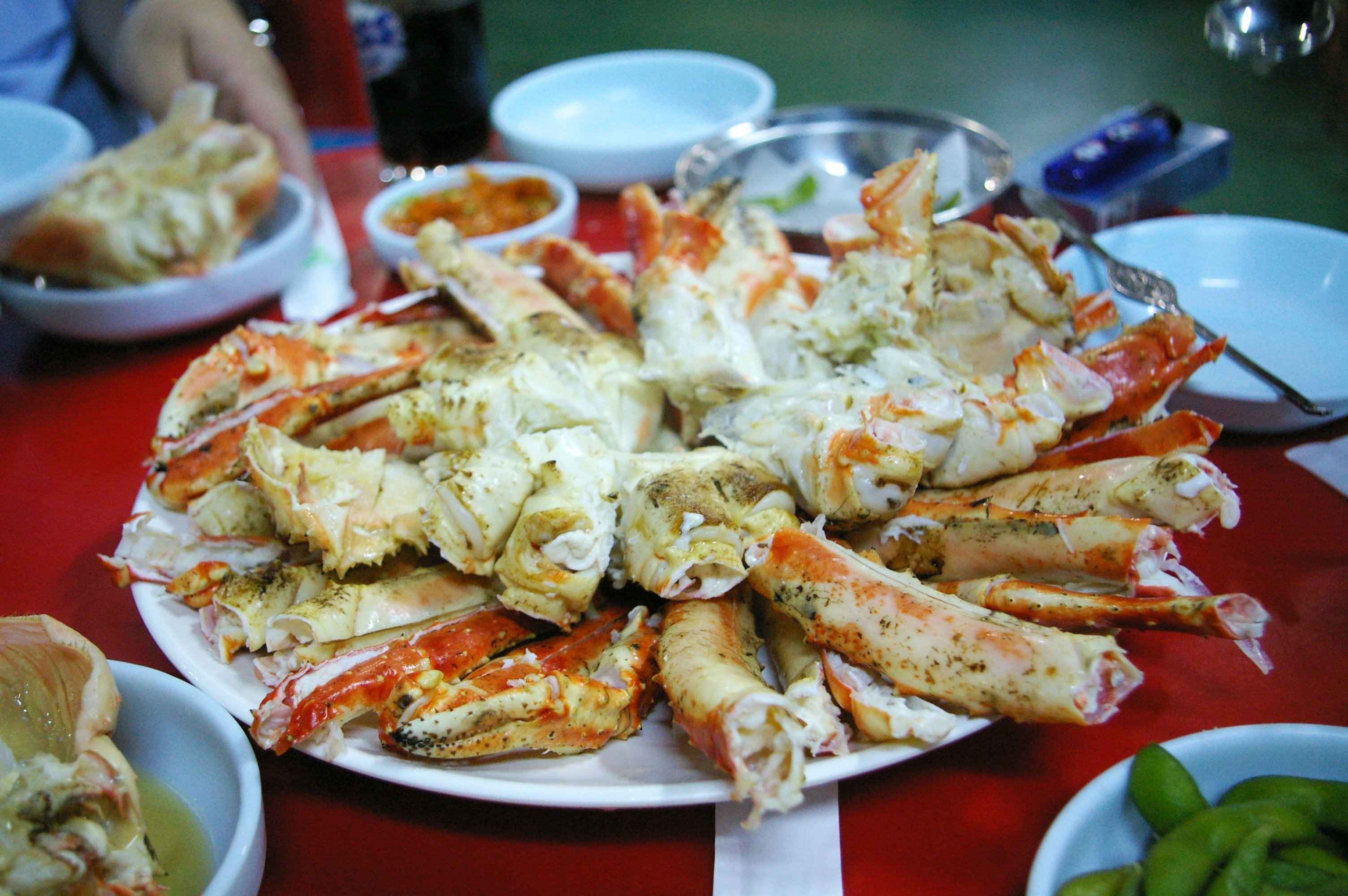
The red of that steamed shell has a name: astaxanthin, a pigment in the shell that turns red with heat. And the crab's own name holds a small trap for English speakers. It looks like "flower crab" — 꽃 is flower — but the food-information service passes on the accepted account that the name comes from 곶 (got), an old word for a pointed cape of land, after the spiked shape of the shell: 곶게 wore down into 꽃게. The crab is named for a headland, not a blossom.
The crabs the law does not cover
Here is the detail that surprises even people who know the closed season exists. The ministry's own guide to lookalike crabs is explicit that the bans bind only the resources listed by scientific name in the decree's annexes. The mud crab called 톱날꽃게 (Scylla paramamosain) and the blue swimming crab called 청색꽃게 (Portunus pelagicus) both carry 꽃게 in their Korean names, and neither has any closed season or minimum size at all.
The point is not that those species are free-for-alls — licensing and area rules still govern fishing generally — but that the species-level protection follows taxonomy, not appearance or naming. A rule built for one Latin name does not stretch to cover its cousins.
Using the calendar
For a market visit, the season rule compresses well. April to June, look for females and think about roe. September to November, look for males and think about meat. In the heart of summer the calendar closes completely: from 16 July to 20 August the three windows overlap, and no Korean waters are open for blue crab at all. Whatever crab is on offer then did not come fresh out of a local sea that week — a gap that is the law working, not the market failing. The size floor is aimed at hobby fishers too: a ministry explainer for recreational anglers stresses checking both the closed season and the minimum size before fishing, notes that undersized crabs are off-limits regardless of season, and, as of its 2020 publication, put the penalty at up to two years in prison or a twenty million won fine.
The dates here are the ones published in the ministry's current documents — the 2026 annex postings and the 2025 species guide — and closed seasons are, as the 2024 island change shows, adjustable. At the time of writing the general window remains 21 June to 20 August; a reader planning around the margins of the season in a future year should check the ministry's current notice rather than trust any article's snapshot, this one included.
A crab bought with its season is one of the easiest good meals in Korea.
Editorial method: Researched and drafted with AI help. The crab's lifespan, spawning months and maturity size come from the National Institute of Fisheries Science species page; the closed seasons, the island windows and the 6.4-centimetre floor from the Ministry of Oceans and Fisheries' 2026 annex postings, its 2025 lookalike-crab guide and its April 2024 release; and the seasonal eating advice and the name's origin from the ministry's seafood-information service. The five photographs are Wikimedia Commons files credited in their captions, and the cover is an AI-generated still life rather than a market photograph.
Sources checked
Last reviewed September 7, 2026.
- 꽃게 어종 정보 — 생애주기·분포·특징 (species detail page) — 국립수산과학원 (National Institute of Fisheries Science)
- 꽃게 3종 금어기, 금지체장 안내 (2025-07-24 guide with PDF) — 해양수산부 (Ministry of Oceans and Fisheries)
- 수산자원의 금어기·금지체장 기준 — 시행령 별표 1·2 (2026-01-01 기준) — 해양수산부 (Ministry of Oceans and Fisheries)
- 백령도·대청도·소청도의 꽃게 포획채취 금지기간이 늦춰집니다 (2024-04-15 press release) — 해양수산부 (Ministry of Oceans and Fisheries)
- 제철 수산물 <가을> 꽃게 (seasonal seafood guide) — 수산물안전정보서비스 (해양수산부 국립수산물품질관리원)
Schedules, prices and operating rules can change. Where a detail is time-sensitive, the linked operator remains the final authority.