In the National Museum of Korea's online collection, a small grey-green box 13.3 centimetres tall sits under a five-word title: 청자 음각 연꽃 무늬 합. To someone still sounding out Hangul, it can look like a line of poetry. It works more like an inventory line, and once its order is clear, titles like it can be read without a ceramics course.
There is one catch, and it is the useful part. The technique word in the title is a label, not a sealed box. The museum's own text describes incision on the exterior of a bowl titled as inlaid, while another record puts two technique names in a bottle's title. Four records, checked on 5 October 2026, make the pattern easy to see.
Read the parts these four titles reveal
Across these four records, 청자 comes first and the vessel word comes last, with one or two technique names in between. Three of these titles name a separate motif; the bottle's title does not. This is a limited reading pattern, not a museum-wide naming rule:
- 청자 (cheongja): the ware type, celadon.
- The technique word: 음각, 양각, 상감, or a pair such as 동화 퇴화.
- The motif, where one is named: 연꽃 (lotus), 모란 넝쿨 (peony scroll), 구름 학 (clouds and cranes).
- 무늬 (munui): pattern.
- The vessel: 합 (hap), 완 (wan) or 병 (byeong).
The pattern slot comes in two registers. The bottle's record gives both 청자 동화 퇴화문 병 and 청자 동화 퇴화무늬 병 for the same object, so the Sino-Korean 문 and the everyday word 무늬 fill the same place in a title. Each record also lists a hanja alternative name. For the crane bowl it is 靑磁 象嵌 雲鶴文 碗, which runs in the same order as the Hangul title, character group by character group.
The vessel words reward a second look. The Standard Korean Language Dictionary describes 합 (盒) as a vessel for food that is not very tall, round and broad, and has a lid, and it writes that definition for brassware; the celadon box shares the shape word. The two bowls titled 완 are filed under 대접 in the museum's classification field, and the same dictionary defines 대접 as a lidless vessel with a wide top and low sides.
음각 and 양각: sunken or standing out
The two carving words are a matched pair. The dictionary defines 음각 (eumgak, 陰刻) in art as carving letters or pictures into a flat surface so that they sink inward. It defines 양각 (yanggak, 陽刻) as carving them so that they stand out. In English, incised and relief are a fair shorthand for the two words, not a description of any particular workshop method.
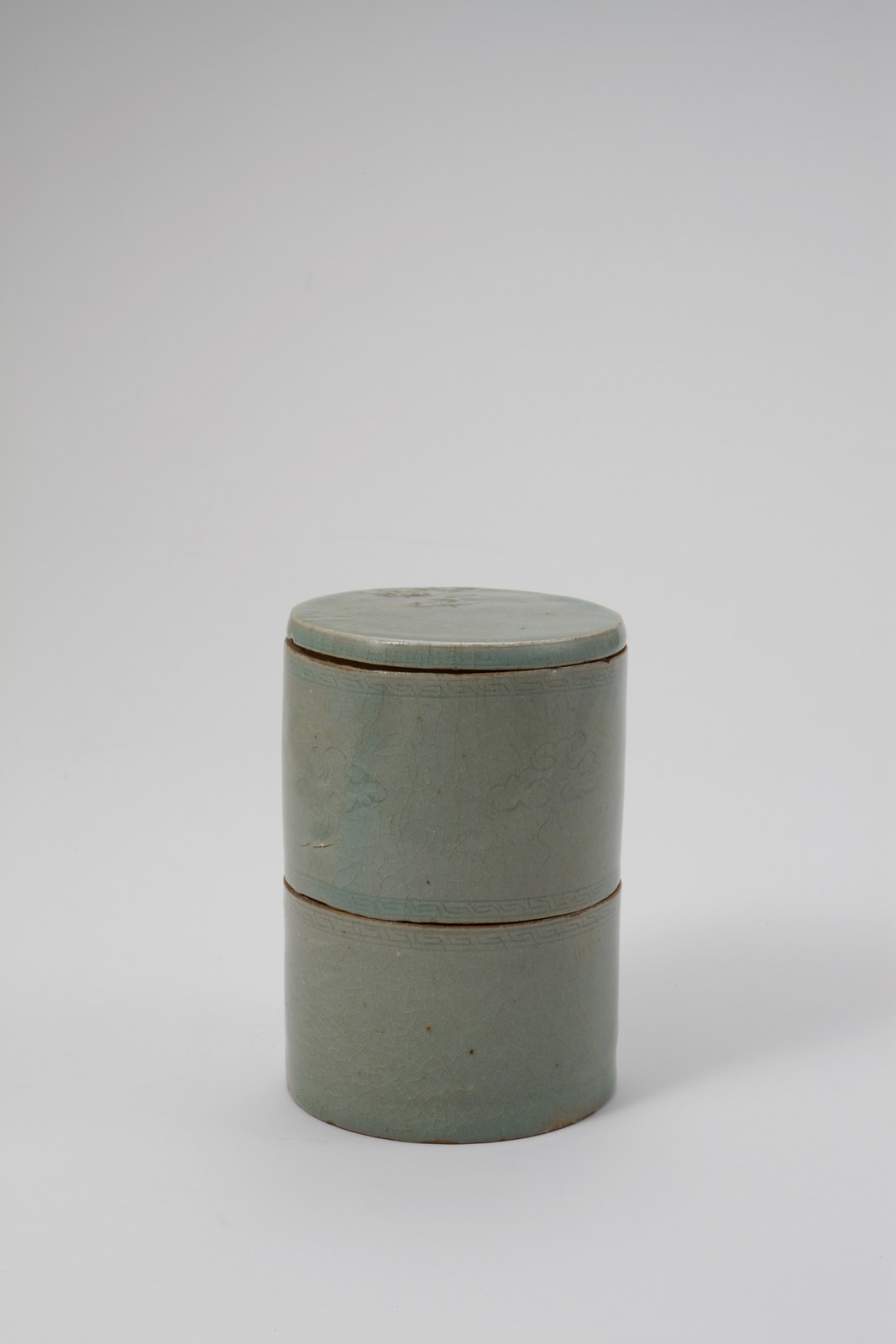
The box, 덕수6319, shows how little a record may add. Its page gives the title, the hanja name, the period as Goryeo, the material, a classification, the size and the number, and no descriptive paragraph. The museum photograph shows fine lines between narrow patterned bands on the side, under a crackled glaze. Only the title and its hanja alternative name carry the technique word.
The relief bowl, 덕수2336, has one descriptive sentence, and it is about shape rather than surface. The museum says the bowl's shape resembles the elegant forms often seen in Song-dynasty Ding or Jingdezhen kiln wares, while the soft finish of its foot and rim reflects a Goryeo sensibility. The record does not say how the relief decoration was produced. It is tempting to fill that gap from general reading about moulds or hand carving. The honest reading is narrower: the museum calls the pattern 양각, and the page stops there.
The inlaid bowl that is also incised
상감 (sanggam, 象嵌) translates as inlay. The dictionary defines it as a craft technique of cutting patterns into the surface of metal, ceramics or wood and setting matching pieces of other materials into them, and it notes that in Korea the technique developed greatly in inlaid celadon and in lacquerware decorated with mother-of-pearl.
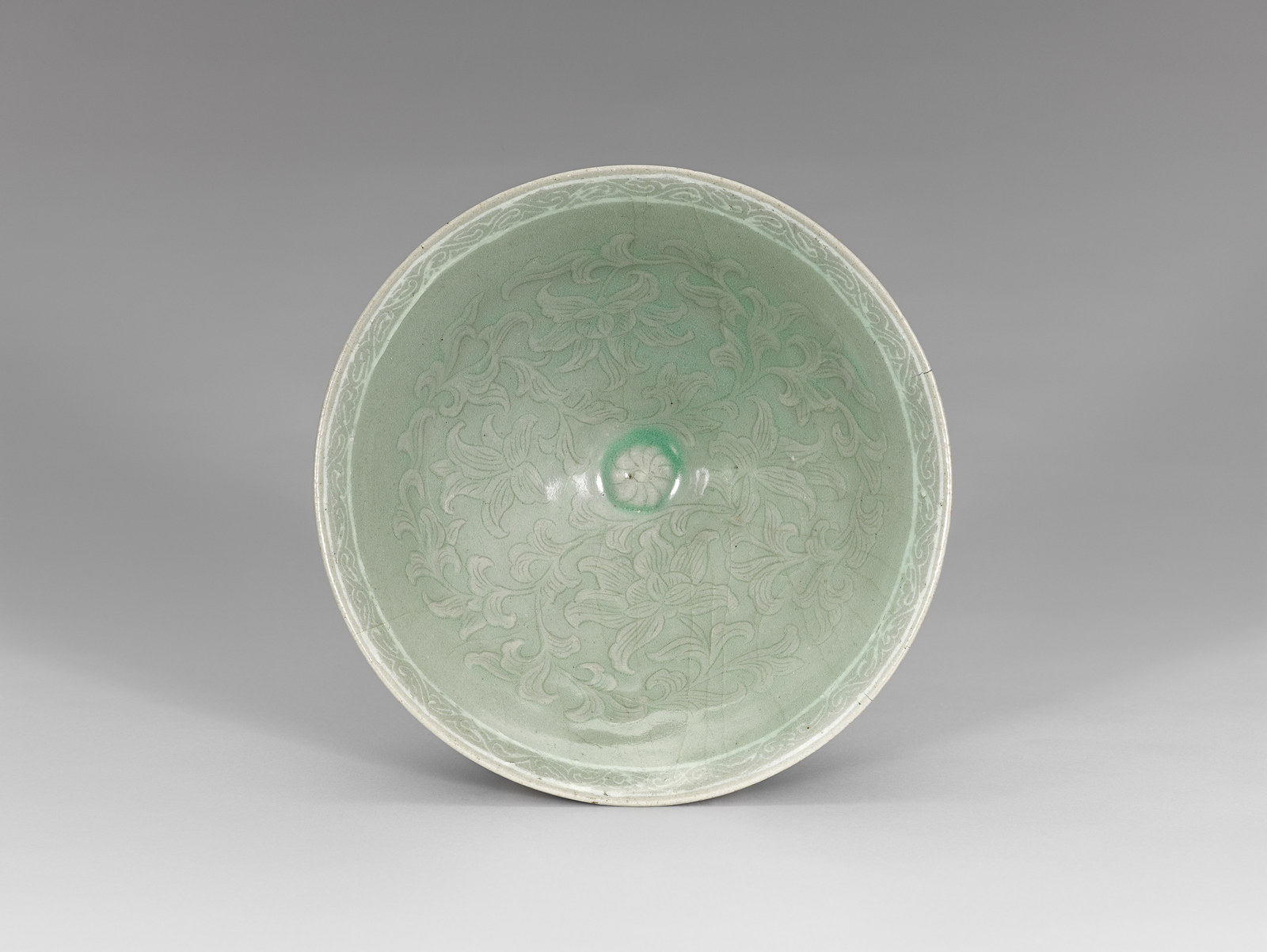
Now the twist. The bowl 덕수3147 is titled 청자 상감 구름 학 무늬 완, celadon inlaid cloud and crane pattern bowl. Its description says early inlaid celadon kept patterns concise and placed them on only the inside or only the outside of a vessel, and that this bowl likewise has only simple incised flower sprays on its outer surface. One bowl, two technique words: 상감 in the title, 음각 in the text. The title carries only one of them.
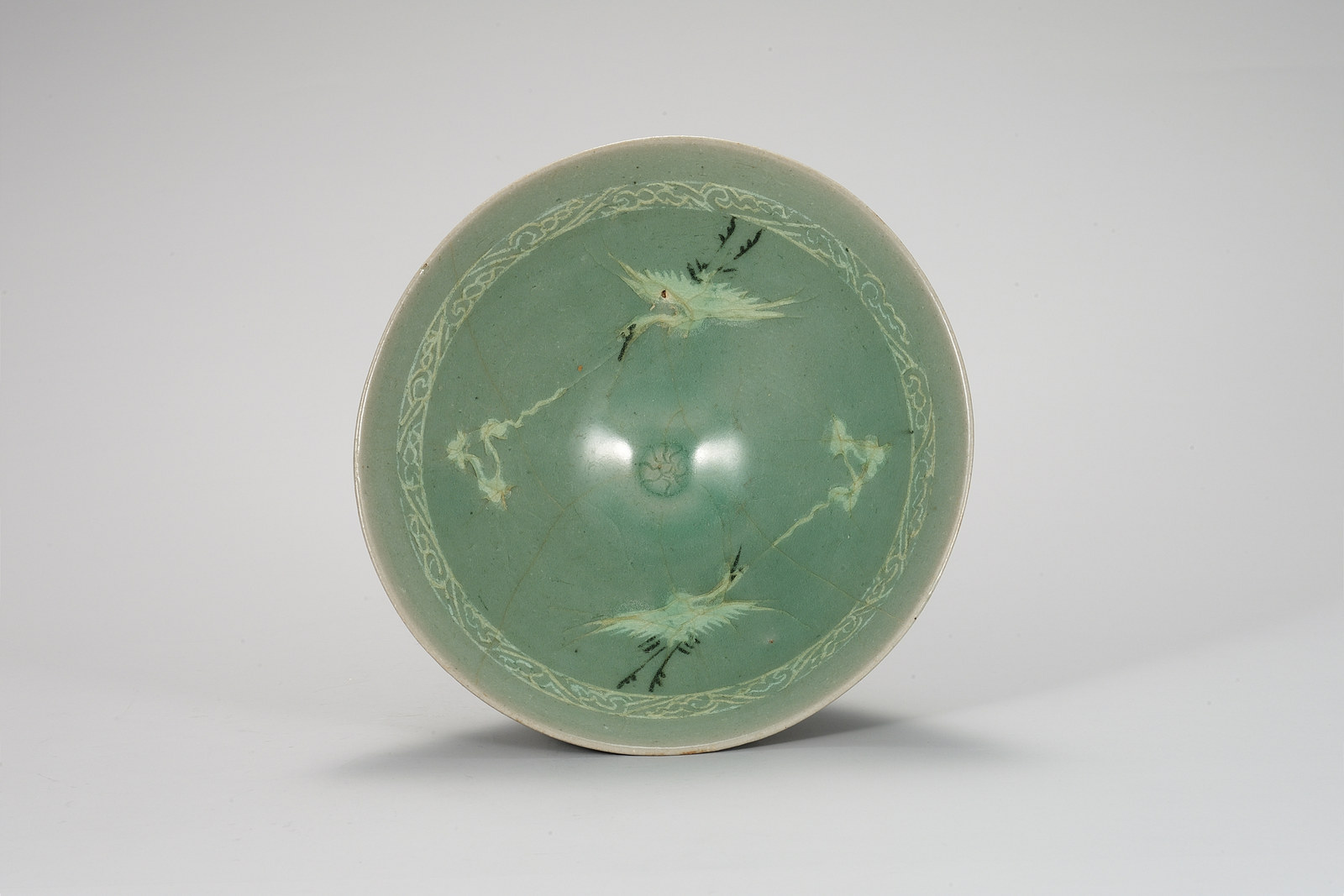
The photograph above is the record's interior view, with pale cranes and clouds, a pale scroll band near the rim and darker details on the cranes. It cannot show the outside, so the incised part of this story rests on the museum's words rather than on the picture. The record also gives the bowl's findspot as near Kaesong, its size as 7.6 centimetres high and 17.6 across, and adds that shards made with this kind of technique have been excavated at the Sadang-ri kiln site in Gangjin, South Jeolla.
A bottle with two technique names in its title
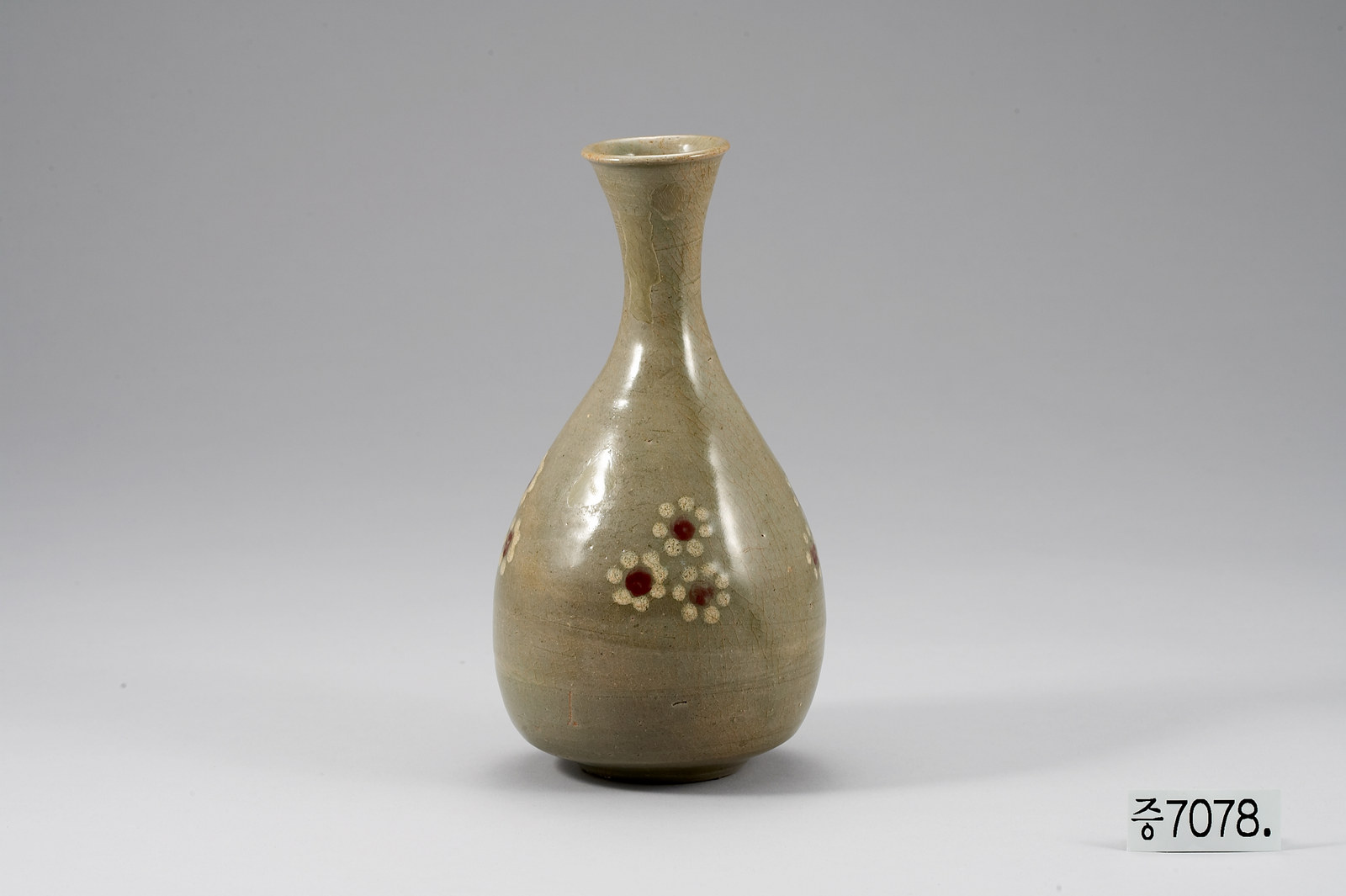
The fourth record does the opposite of the crane bowl: its title names two techniques side by side. 증7078 is 청자 동화 퇴화무늬 병. The museum says the bottle's body is decorated with flowers whose centres were dotted in 동화 (銅畵) and ringed with white 퇴점 (堆點) dots. Its description uses 퇴점 for those surrounding marks, whereas the title uses 퇴화 (堆花); the two words are not treated as interchangeable here.
The words need hanja to make sense. The dictionary lists 동 as a synonym of 구리, copper, the 銅 of 銅畵, so this guide renders 동화 on the label as copper painting. It defines 퇴화 (堆花) in crafts as making a pattern by laying paint thickly on the body of a ceramic. The museum adds that 동화 is mainly found on dishes and that bottles decorated with it are rare. Its record also notes repair traces on the mouth and neck, a dent of about 1.2 centimetres, wheel-throwing marks on the body, and a foot fired standing on sand.
Here is the gentle trap for anyone leaning on a word-by-word reading. A dictionary search for 동화 returns seven headwords, including 童話, a children's story, and 銅貨, a coin made of copper, and no separate headword for the ceramic 銅畵. 퇴화 is listed twice: the craft term, and the everyday 退化, going back to an earlier state. Read without hanja, the bottle could come out as something like a fairy-tale degeneration bottle. The hanja on the record is what keeps it a copper-painted, dotted celadon bottle.
A snag worth knowing: numbers against the photograph
The same bottle record lists height 10.5 cm, mouth diameter 4.5 cm, maximum diameter 19.7 cm and base diameter 5.2 cm. Read literally, that is a bottle nearly twice as wide as it is tall. The museum's own photograph shows a bottle roughly twice as tall as it is wide, so the height and the maximum diameter appear to be swapped. That is an inference from comparing the figures with the picture; the record itself does not flag it.
The mismatch is not a reason to distrust the whole record. It shows why a label is best read as a set of fields that support one another: the title, the description, the numbers and the photograph. When they disagree, the disagreement is information too.
A checklist to test against the next record
Use these four titles as examples, then check each new title against its own record rather than assuming it fills all five parts.
- Look after 청자 for possible technique names, and confirm their meaning against the record.
- Translate the technique word: 음각 sunken, 양각 raised, 상감 inlaid, 퇴화 thickly applied pattern, and 동화 copper painting when the hanja is 銅畵.
- Read the description, if there is one, for a technique the title leaves out.
- Check the hanja alternative name whenever a Hangul word has everyday homophones.
- Compare the photograph with the size fields, and keep the collection number, such as 덕수3147, to find the record again.
What the labels leave out
This guide reads four records as they stood on 5 October 2026. Collection pages are live databases, so a description, a photograph or a size can change. The item pages verify the technique names and what each description says; they do not explain in detail how 음각 or 양각 decoration was made, and nothing here should be read as a guide to dating, authenticating or valuing a piece. The photographs are National Museum of Korea works shared under KOGL Type 1, which allows reuse with attribution; the museum has not reviewed or endorsed this guide.
Technique words are only one layer of a Korean museum label. Another layer is the designation itself, and the guide to why Korea's National Treasures lost their numbers explains what 국보 and 보물 mean and why the old numbers disappeared from plaques.
Editorial method: AI assisted the research and drafting of this guide inside an evidence-gated editorial pipeline. Object facts come from four National Museum of Korea collection records checked on 5 October 2026, word meanings come from the National Institute of Korean Language's Standard Korean Language Dictionary, and the apparent dimension mismatch and the limited reading-order pattern are marked as inferences. The photographs are National Museum of Korea works used under KOGL Type 1 and resized for this page, and the cover is an AI-generated editorial still life, not a museum photograph.
Sources checked
Last reviewed October 5, 2026.
- 청자 음각 연꽃 무늬 합 (덕수6319), collection record — 국립중앙박물관 (National Museum of Korea)
- 청자 양각 모란 넝쿨 무늬 완 (덕수2336), collection record — 국립중앙박물관 (National Museum of Korea)
- 청자 상감 구름 학 무늬 완 (덕수3147), collection record — 국립중앙박물관 (National Museum of Korea)
- 청자 동화 퇴화무늬 병 (증7078), collection record — 국립중앙박물관 (National Museum of Korea)
- 공공누리 제1유형: 출처표시 (KOGL Type 1 terms) — 공공누리 (Korea Open Government License)
- 표준국어대사전: 음각 (陰刻) — 국립국어원 (National Institute of Korean Language)
- 표준국어대사전: 양각 (陽刻) — 국립국어원 (National Institute of Korean Language)
- 표준국어대사전: 상감 (象嵌) — 국립국어원 (National Institute of Korean Language)
- 표준국어대사전: 퇴화 (堆花, 退化) — 국립국어원 (National Institute of Korean Language)
- 표준국어대사전: 동화 (search result) — 국립국어원 (National Institute of Korean Language)
- 표준국어대사전: 구리 (≒ 동) — 국립국어원 (National Institute of Korean Language)
- 표준국어대사전: 합 (盒) — 국립국어원 (National Institute of Korean Language)
- 표준국어대사전: 대접 — 국립국어원 (National Institute of Korean Language)
Schedules, prices and operating rules can change. Where a detail is time-sensitive, the linked operator remains the final authority.