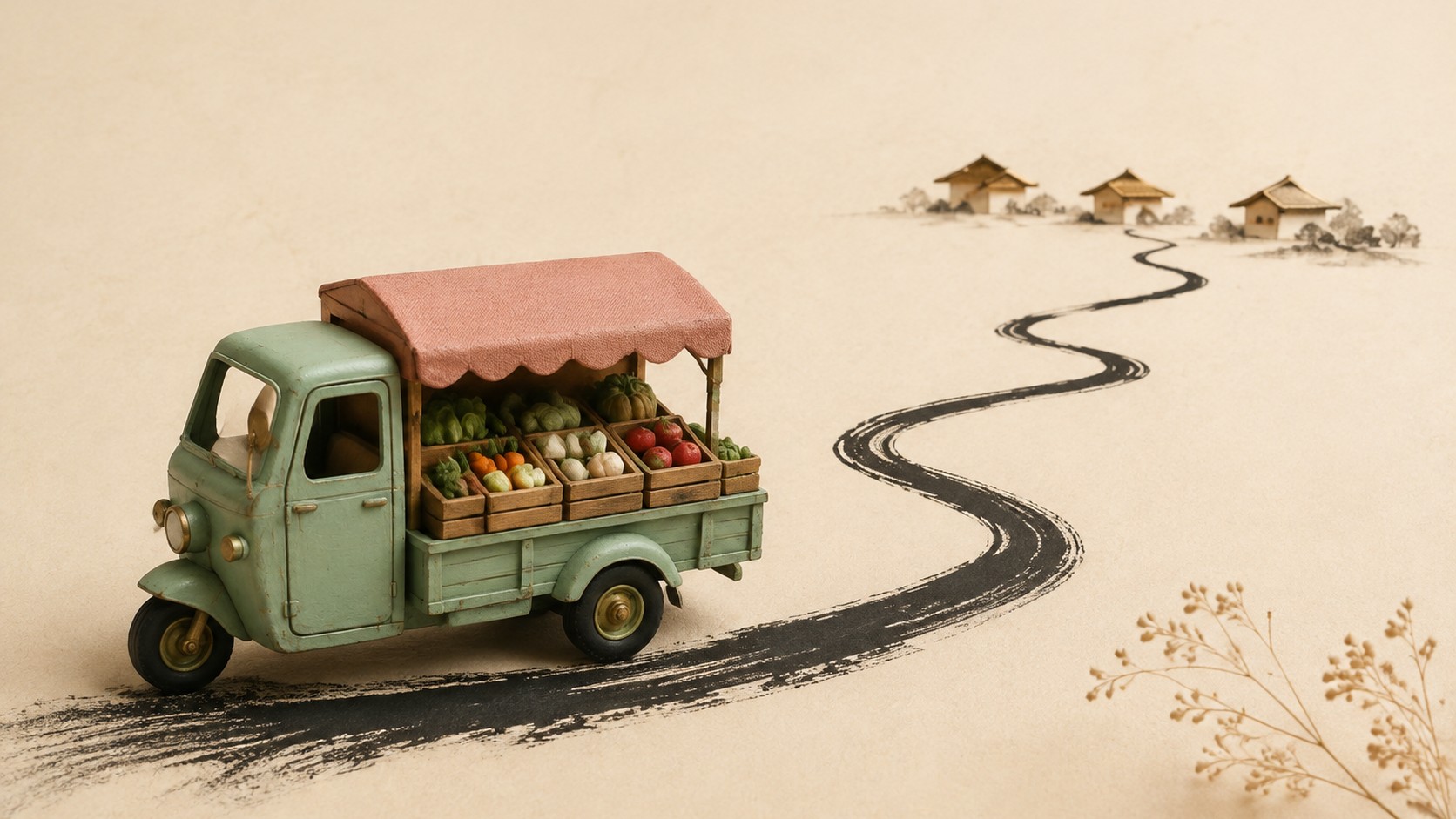
Picture a Korean village on a weekday morning: rice fields, a village hall, a bus stop, and nowhere to buy food. Not a closed shop, not a small shop: no food shop at all. Then a small truck turns off the county road, folds open its side wall, and for the next half hour it is the supermarket.
That truck is not a nostalgic curiosity. It is current Korean rural policy, and the numbers behind it are startling for anyone who knows Korea as the country where a convenience store waits on every corner. According to the agriculture ministry's tabulation of the 2020 agricultural census, 27,609 of Korea's 37,563 rural administrative villages, 73.5 percent, have no food or beverage retail business inside the village. Meanwhile the Fair Trade Commission counted 55,927 franchised convenience stores nationwide in its 2025 franchise statistics. Set side by side, the arithmetic is blunt: Korea has roughly twice as many franchised convenience stores as it has villages without a single food shop.
Two Koreas of retail
The word for what happened to these villages is borrowed. As a Korea Rural Economic Institute commentary notes, the term food desert was coined in 1990s Scotland for urban neighbourhoods where basic groceries were out of reach. In Korea the desert is rural, and it is measured. Statistics Korea's 2020 agricultural census counts those 37,563 villages across the countryside's eup and myeon districts, the units the ministry's tabulation calls 행정리 (haengjeongni, administrative villages). The ministry's own definition of the problem is plain: rural population decline and weak transport make village shops disappear, until food and daily necessities are hard to buy at all. The same census tabulation adds a harder detail: 2,224 villages, about six percent, have no public transport of any kind.
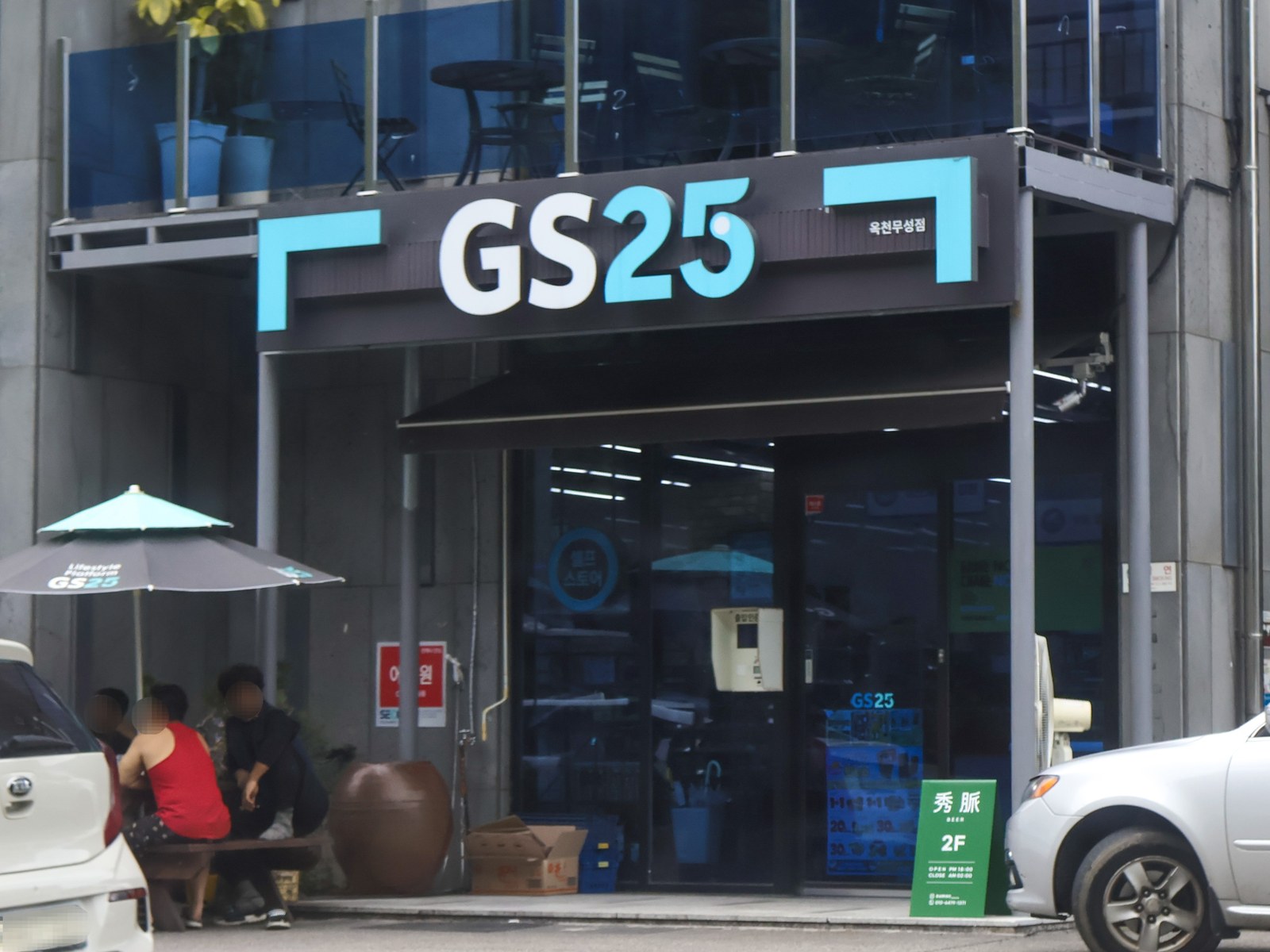
Why did the shops die? A KREI senior researcher, citing the institute's 2022 research, describes population thresholds below which rural services start to vanish: hospitals below roughly 3,205 residents, pharmacies and noraebang below 2,604, restaurants below 1,882. A village shop needs customers, and the same arithmetic applies as a village ages and empties, though the commentary's published list stops short of a retail threshold. The cruel twist in that same analysis is that the hardware kept improving: rural water supply reaches 82.8 percent, sewerage 76.6 percent, road paving 99.8 percent. The roads are paved; there is just nowhere left to walk to.
A separate peer-reviewed 2024 study by two KREI researchers, an exploratory spatial analysis of travel times, found rural residents must travel farther and longer than city dwellers to buy food, with residents of myeon districts, the deepest countryside, most exposed. Among the authors' recommendations is one the government had already announced months before the study appeared: supporting local mobile shops.
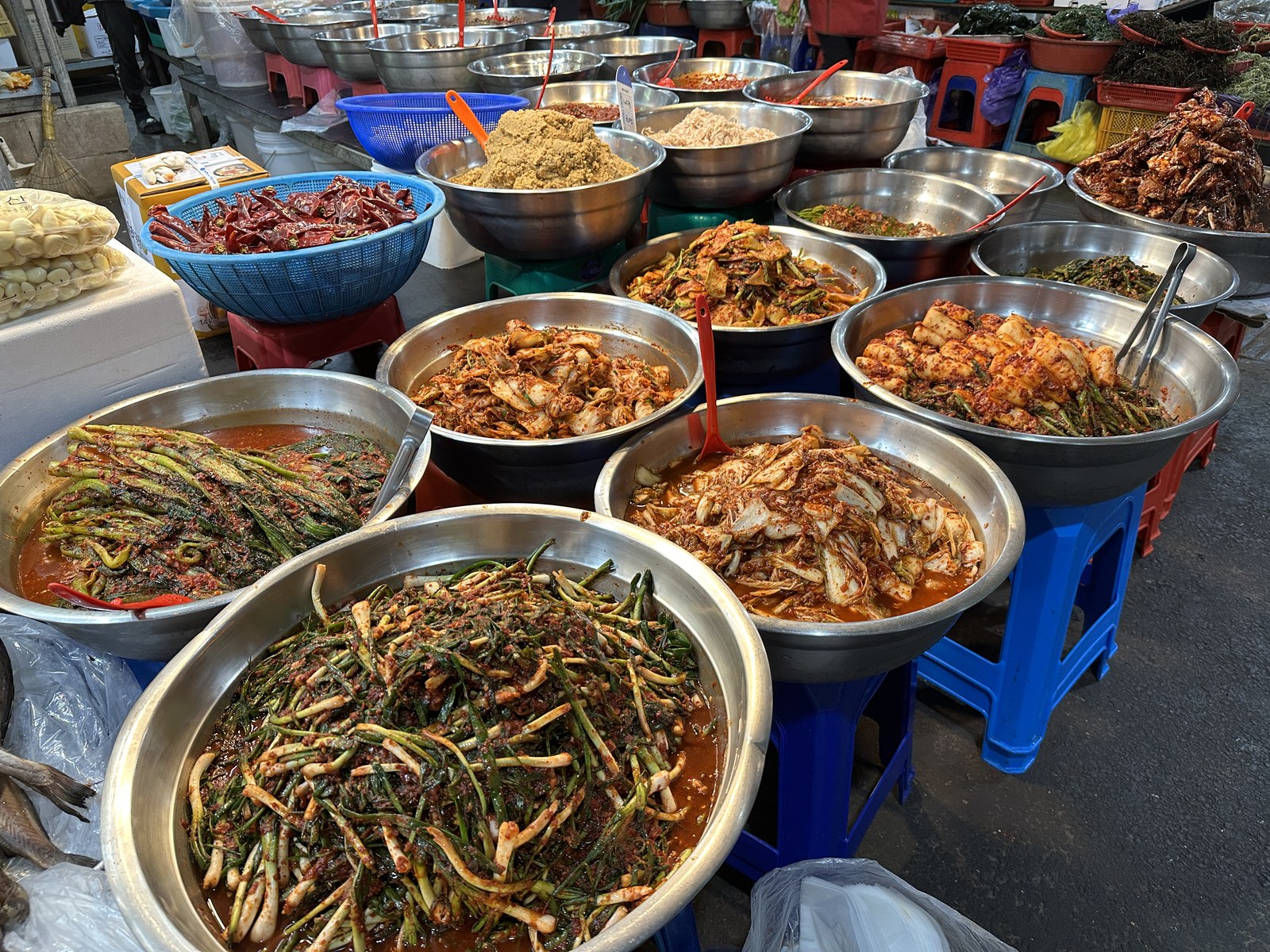
The state's answer is a truck
In July 2024 the agriculture ministry announced a national program with a homely name: 가가호호 농촌 이동장터 (gagahoho nongchon idongjangteo, the door-to-door rural mobile market). The design is a division of labour. The ministry subsidizes the converted trucks and equipment; the county arranges staff and routes with private partners such as Nonghyup's Hanaro Mart chain or local retailers. At the kickoff meeting, 8 of the 18 cities and counties that had expressed interest attended with their regional agricultural co-ops.
The government did not invent the idea; it adopted it. The meeting was held, pointedly, in Myoryang-myeon in Yeonggwang, where a community group called 여민동락공동체 has been loading daily necessities onto a truck since 2010 and selling to 42 villages twice a week. Since 2019 an agricultural co-op in Pocheon has run its own version for vulnerable residents, and the ministry said it would distribute an operating guideline for counties, written with Nonghyup and reflecting the opinions raised at the meeting.
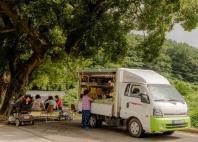
Two counties, two models
What makes the picture interesting is that counties answer the same gap in visibly different ways, and two of them made news in the same week of September 2026. Neither announcement, the county's in Okcheon and the self-sufficiency centre's in Jangsu, names the ministry program; each is a local answer to the same gap.
Okcheon, in North Chungcheong, published an operating report for its 찾아가는 행복슈퍼 (chajaganeun haengbok syupeo, visiting happiness supermarket). The county's truck serves 63 villages across four myeon districts, running five days a week and reaching each village once every two weeks. It carries about 220 items, averaged around 800,000 won in daily sales in August, and recently obtained approval for mobile livestock sales, so fresh chicken, pork and beef now ride along. The county frames the truck as linked to the rural basic-income scheme, aiming to raise daily convenience while keeping spending inside the region. This is the retail model: a county running a small shop on wheels at real volume.
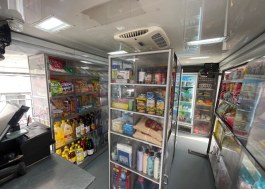
Jangsu, a county in North Jeolla that attended the ministry's 2024 kickoff meeting as one of eight interested cities and counties, took a different route. According to a Yonhap wire report of 4 September 2026, the local self-sufficiency centre, a welfare organisation, began running a 장수 이동 점빵 (Jangsu idong jeomppang, mobile shop) in September, visiting an initial 41 transport-poor villages once a week for stops of about thirty minutes, with plans to expand the items and villages if the response is good. Local press adds that it will run as a pilot through the end of the year. The same reports describe it as a jobs program as much as a shop: the people staffing the truck are participants in self-sufficiency employment, and providing them with stable work is a stated purpose of the project.
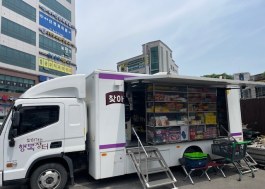
Reading the countryside as a visitor
None of this is a reason to avoid rural Korea; it is a reason to read it correctly. Shops cluster where the towns are, in the eup and myeon centres, and thin out to nothing in the villages between them. If a countryside stay is on the itinerary, treat the town as the pantry stop, the way residents do. The countryside's older answer to the same geography is also still running: the 오일장 (oiljang, five-day market), the traditional market that returns to a town on a five-day cycle, and market day remains one of the best things a visitor can stumble into.
The honest boundary of this guide: the headline figures come from the 2020 census as tabulated by the ministry in 2024, and the two county programs are dated to early September 2026, one of them a pilot that could change or end with the year. The national program is new, the trucks are small and they are not everywhere. But the direction is clear, and it says something quietly moving about how Korea is choosing to serve its emptiest places: when the last shop leaves a village, the shop learns to drive.
Editorial method: This guide used AI for research support and drafting. The village counts come from the agriculture ministry's 2024 tabulation of Statistics Korea's 2020 agricultural census, the convenience-store total from the Fair Trade Commission's 2025 franchise statistics, the service thresholds from a Korea Rural Economic Institute commentary, the travel-time finding from a peer-reviewed KREI study, and the Okcheon figures from the county's own 4 September 2026 report. The Jangsu pilot rests on a Yonhap wire report and local press rather than an official notice, which is why it is attributed to them. Two photographs come from Wikimedia Commons and four from the ministry's press materials under Korea's KOGL Type 1 licence, each credited in its caption. The cover image is AI-generated.
Sources checked
Last reviewed September 5, 2026.
- 농촌 식품사막의 오아시스가 될 '가가호호 농촌 이동장터' 추진하여 삶의 질 높인다 (2024-07-29 program announcement and census tabulation) — 농림축산식품부 (Ministry of Agriculture, Food and Rural Affairs)
- 2020년 농림어업총조사 결과(지역조사 부문) (2021-12-14 census release) — 통계청 (Statistics Korea)
- 식품사막과 농촌 삶의질 (KREI논단, 2024-10-22) — 한국농촌경제연구원 (Korea Rural Economic Institute)
- 한국 농촌 지역 '식품 사막' 분포에 대한 탐색적 연구 (『농촌사회』 34(2), 2024, peer-reviewed study) — 유찬희·손경민 (KREI), via KCI
- 옥천군 '찾아가는 행복슈퍼', 농촌마을 장보기 불편 해소 (2026-09-04 operating report) — 옥천군 (Okcheon County)
- 2025년 가맹사업 현황 통계 발표 (franchise statistics) — 공정거래위원회 (Fair Trade Commission)
- '장수 이동 점빵' 운영 보도 (2026-09-04 wire report) — 연합뉴스 (Yonhap News Agency)
- 장수이동점빵 시범 운영 보도 (2026-09-04 local press report) — 전북제일신문 (Jeonbuk Jeil Shinmun)
Schedules, prices and operating rules can change. Where a detail is time-sensitive, the linked operator remains the final authority.